



Nobody wrote it down. For as long as humans have walked the earth, mating ran on an agreement that was older than language, older than agriculture, older than anything we’d recognize as culture. Hormones enforced it. Scarcity kept it honest. And the small community you were born into, which you couldn’t leave without probably dying, served as the only court that mattered.
Men competed for access to women. They hunted dangerous animals, fought other men, built shelter, proved under real pressure that they could keep a family alive. Women watched them do it and chose. This wasn’t passive. Choosing a mate when the wrong pick meant dead children is one of the highest-stakes bets a person can place, and the filter had been tested across hundreds of thousands of years of fatal mistakes. Women who chose poorly died more. So did their kids. Men who couldn’t compete didn’t pass on their genes. Two pressures, both merciless, running longer than any civilization or religion on this planet.
Both sides paid when they got it wrong. A man who failed to provide got left behind or killed. A woman who misjudged a partner watched her children go hungry. The consequences came fast and they hurt, which is why the arrangement produced functional results for as long as it did.
Inside that system, a few things stayed constant. Competition among men was local. You weren’t measured against every male alive, you had no chance of even knowing about them. It was the forty or sixty guys in your tribe, your village, maybe the next valley or two. In the first cities, it was the guys in your neighborhood, and street. The neighboring district was a different world. The hierarchy was visible to everyone, who was capable, who was reliable, who was dead weight. No algorithm ranked you. It happened in the open, and your reputation, built slowly and destroyed quickly and always in front of people who knew you, was the only thing that mattered.
Marriage was part economic partnership, part reproductive alliance, part insurance against a world that would kill you alone, and only in small part about love. Divorce took different forms across cultures but carried real cost everywhere. Communities were small enough that breaking up meant both people faced consequences. You couldn’t disappear into a city. You couldn’t reinvent yourself with a better profile picture.
Reminder: You can get tons of members-only content dedicated to useful knowledge, and support our Mission at the same time for a few dollars per month 👇
Two full-length, new articles every single week
Access to the entire archive of useful knowledge that built the West
Get actionable principles from history to help you navigate modernity
Support independent, educational content that reaches millions
Hypergamy (women choosing partners of equal or higher status) was bounded by geography. A woman in a medieval village couldn’t hold out for someone three social classes above her. He didn’t exist in her world, she picked the best available man from a limited pool, and that limitation is what kept the whole thing working. Most men had a realistic shot at partnership. Most women found someone adequate. Nobody got what they wanted. That’s how you knew the system was functional.
Marriage was what you built your life on top of. You married young, figured it out together, grew into adulthood as a unit. It wasn’t a reward you earned after getting your career right and your apartment right and your personal brand figured out or after having had enough experiences to fill your Instagram. It was the foundation. Everything else came after.
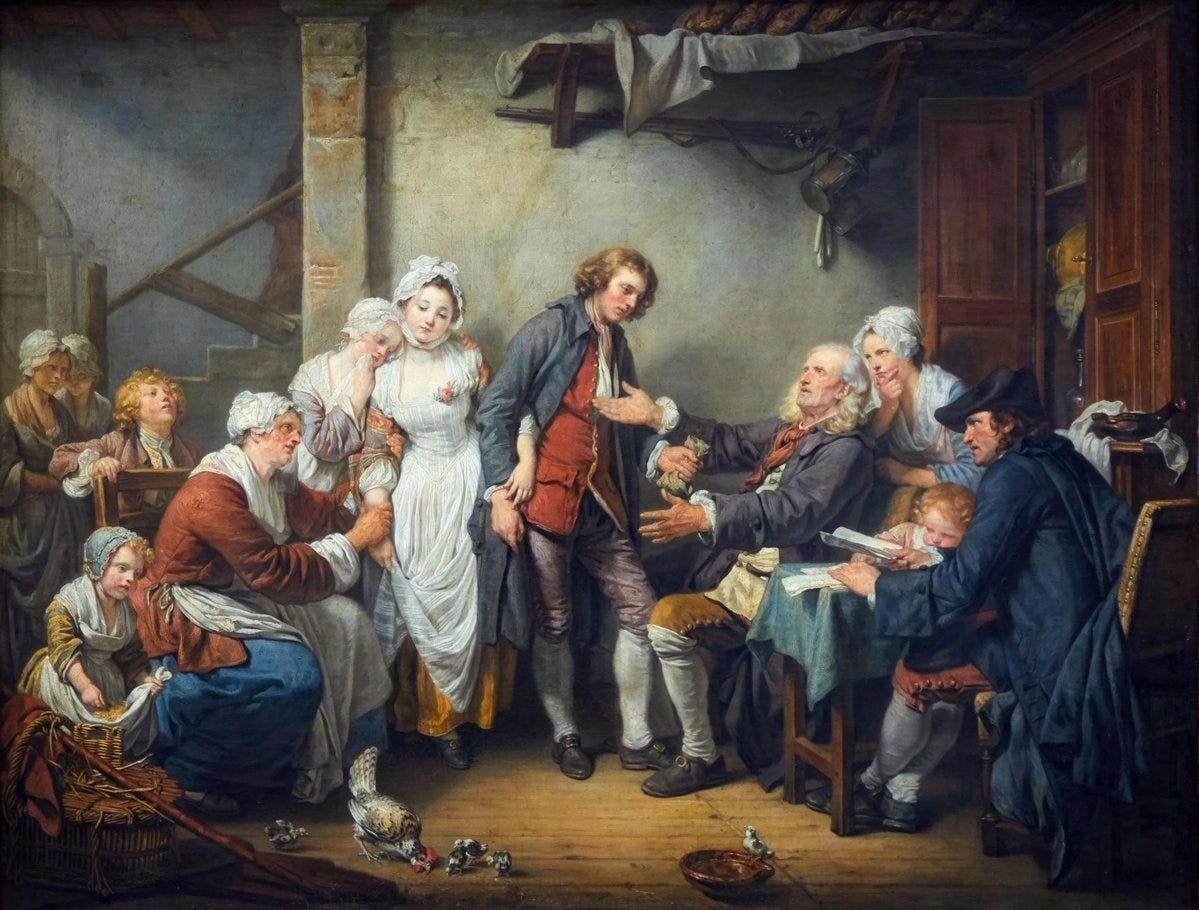
Courtship was not recreational. It was a high-stakes negotiation conducted through signals both parties understood. A man demonstrated fitness through action: hunting, protecting territory, building shelter, winning fights when fights were necessary. A woman demonstrated selectivity through restraint. She didn’t, and couldn’t, merely accept the first offer that came along, and she certainly didn’t make pursuit easy. What she required was proof. The pursuit itself was the proof. A man who wouldn’t persist through difficulty wouldn’t have been able to provide for and protect his family in a world where the default situation was painful death. Her resistance was what made the connection meaningful.
The oxytocin research points where you’d expect it to. Men in committed relationships who receive oxytocin actively avoid proximity to attractive alternatives. The neurochemistry of bonding is a biological lock-in mechanism, calibrated to function within monogamous pair-bonding. Break the structure and the mechanism still fires, but it fires into nothing. Or worse, it fires over and over in shallow encounters that drain the system without producing the bond it was built to secure.
The gender equality paradox tells you how deep this goes. In the countries with the most freedom and the least gender-based barriers, Finland, Norway, Sweden, women choose stereotypically feminine careers at higher rates than women in less equal societies. People argue about the specifics (which metrics, which countries, how large the effect). But the direction of the finding replicates over and over: give women more freedom, and they sort more along biological lines, not less. Those preferences have been running since the species appeared. Two decades of Tinder and half a century of second-wave feminism were never going to overwrite them.

I’m not saying we should return to arranged marriages (even if they have remarkably lower divorce rates than conventional ones). I’m not saying women shouldn’t have autonomy. What I am saying is harder to sit with: what we replaced the old system with is not a system at all. It’s a sequence of demolitions, carried out by technologies and policies and ideologies that didn’t understand what they were tearing apart. Nobody stopped to ask if the replacement would function.
It didn’t.
How the Competition Went Global
The contract didn’t break all at once. Five forces eroded it, working on different layers, reinforcing each other. Any one of them could have been absorbed alone, together, they were lethal.
Start with the most visible one. The internet and social media changed both how men and women find each other and the mating market itself.
Until yesterday, your competition was local. A young man in a village of two hundred was up against maybe forty other men of reproductive age, and he could see every one of them. He knew who they were, where he stood, and what he had to do. The hierarchy was readable and it was escapable. If you ranked low in one group, you could try another. The search space was small enough that hard work could actually change your position.

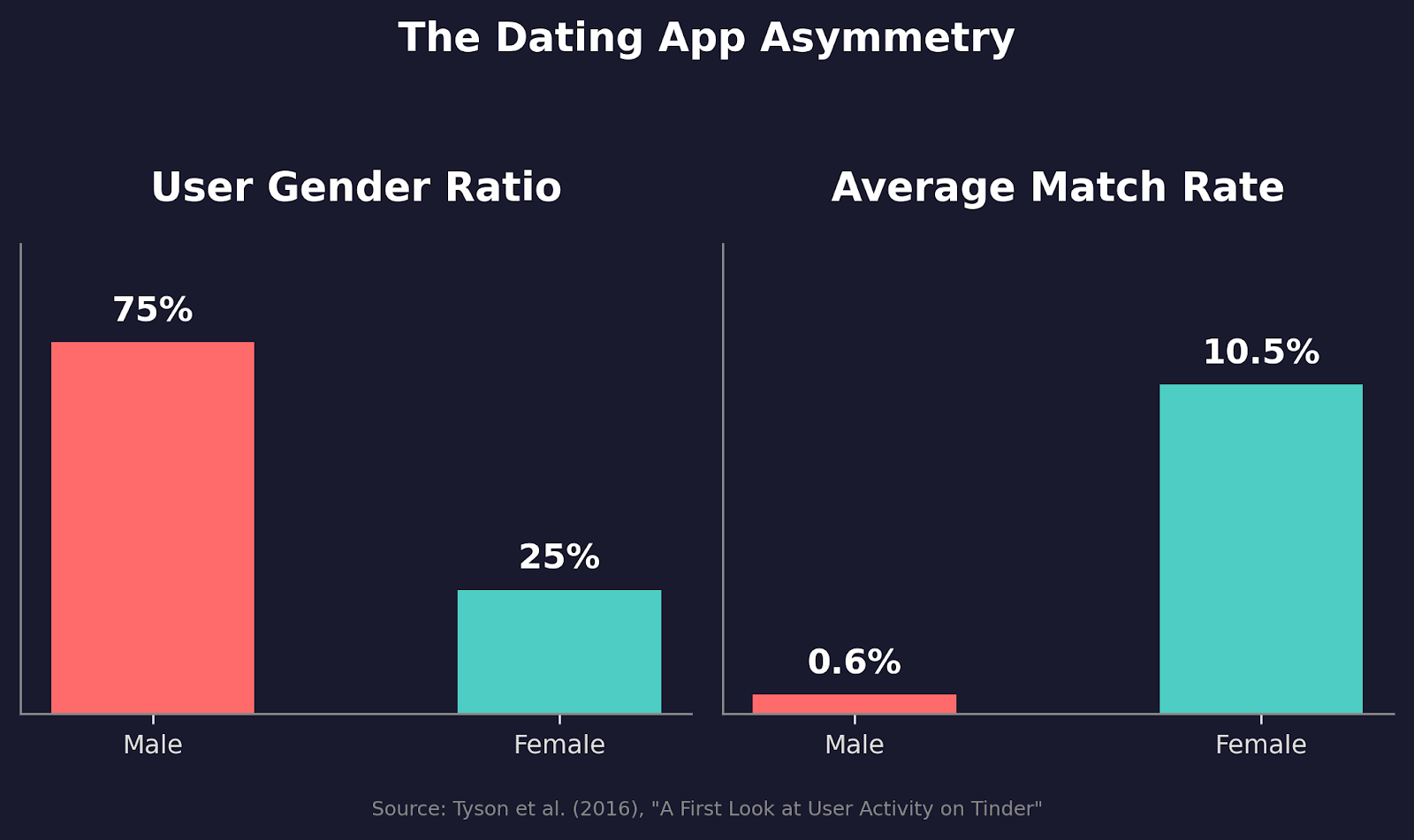
The internet collapsed that geography overnight. A woman in Brooklyn is no longer choosing from the men in her neighborhood, her church group, or her circle of friends. She’s choosing from what feels like an infinite catalog. Dating apps made this literal. On Tinder, the gender ratio runs roughly three men to every one woman. Some platforms skew four to one. The average man’s match rate sits around 0.6 percent while for the average woman’s is more than ten percent. Women on apps are far more likely to feel overwhelmed by messages, while men are far more likely to feel invisible. Both come out worse.
When you take a mating market that functioned because it was locally bounded and you remove all the boundaries, you don’t get a better market. You get a broken one. Women experience paralysis from too many choices (the same psychological mechanism that makes people unable to pick a jam when you offer them thirty varieties instead of six). Men experience invisibility. Neither side gets what it actually wants, which is a real relationship with a specific person. But the apps don’t need either side to succeed. They need both sides to keep swiping.
Dating apps are the only consumer product whose business model requires them to fail at their stated purpose. If Hinge actually delivered on the promise of being “designed to be deleted,” it would have no users. Match Group, which owns Tinder, Hinge, OkCupid, and several others, reported roughly $3.3 billion in revenue in 2023. That revenue comes from people who haven’t found what they signed up for. The product is the search. And the search is engineered to never end.
But technology did something worse than distort the matching market. It made the social cost of failure permanent. Before the internet, if you walked up to a woman at a bar and she turned you down, the embarrassment was contained to that room, that night, those witnesses. Now a failed and embarrassing approach can be filmed and posted and captioned with something humiliating and viewed by millions of people forever. A woman recently went viral for posting about how she wished she could meet a man at church. The same woman then publicly shamed a man who approached her at church for doing exactly that. This isn’t a contradiction in her mind. It is a contradiction in the incentive structure. She wants to be approached, but the culture has made approaching into a reputational landmine that is permanent and global and searchable. So men stopped approaching. And then women complained that men stopped approaching.
The consent framework accelerated the great male checkout. In its most extreme institutional form, particularly on university campuses governed by Title IX tribunals, the standard for sexual misconduct expanded to where the border between regretted sex and rape became almost impossible to see. High-profile cases demonstrated that an accusation alone could end a man’s career (and at times life) before any proof of wrongdoing. Men watched this happen to their peers and drew the rational conclusion: the risk of approaching women is potentially life-destroying. The culture demanded that men be bold enough to initiate and also certain enough to guarantee the initiation was wanted before it happened. But the whole point of romantic initiation is that you don’t know. Courtship requires risk. The consent bureaucracy demanded certainty and documentation at every step, and in doing so it didn’t make sex safer. It killed the spontaneity that makes romance possible. It replaced the oldest human dance with a liability negotiation.
The men who internalized these rules stopped approaching. The men who ignored them kept going. And then the culture, having systematically selected against conscientiousness in the dating pool, expressed bewilderment at the quality of the men who remained.
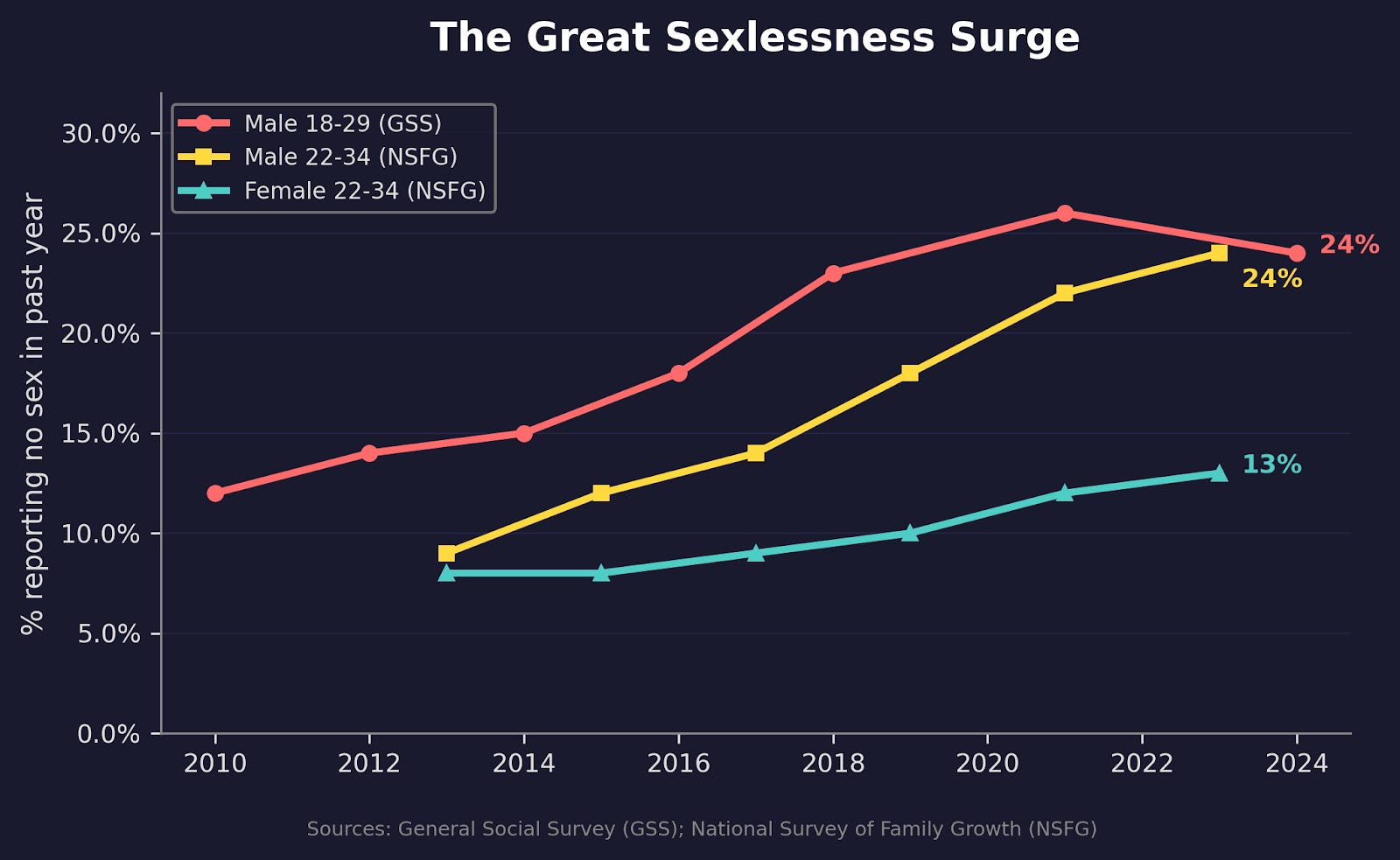
The results are already visible. Young adults are having the least sex in recorded history. According to the General Social Survey, sexlessness among 18-to-29-year-olds doubled from 12 percent to 24 percent between 2010 and 2024. The National Survey of Family Growth found that male sexlessness in the 22-to-34 range nearly tripled from 9 percent in 2013 to 24 percent by 2023. For women, the increase was smaller but still real, from 8 to 13 percent. More than 60 percent of young men are currently single. One in three Gen Z men has never had partnered sex. And the sex recession is not being driven by a small number of men monopolizing all the women, which is the narrative the internet prefers. The Institute for Family Studies analyzed the data directly: the decline was driven almost entirely by a drop in the number of men and women with exactly one sexual partner. Monogamous coupling declined. Promiscuity didn’t increase. People aren’t having more casual sex. They’re having no sex. They are alone.
What Pornography Did to the Brain
Your brain was not built for the world you live in. I’ve argued this at length elsewhere, but it needs restating because it’s the biological substrate underneath everything else.
The human dopaminergic system evolved for environments where nothing came easy. Food was scarce, so the brain learned to prize anything calorie-dense. New sexual partners were rare, so the brain wired itself to respond powerfully to novelty, the Coolidge effect, documented across nearly every mammalian species. Social approval was limited to your immediate group, so the brain learned to crave it from the people physically around you.
Then modern technology poured superstimuli into every one of those circuits. Food got engineered to a bliss point that maximizes consumption without ever producing fullness. Social media introduced variable-ratio reinforcement, the exact reward pattern that makes slot machines impossible to walk away from. And pornography offered unlimited novelty with no cost, no effort, and no risk.
What happened next is neuroscience. The brain got overloaded. When any neural pathway receives too much input for too long, sensitivity drops, thresholds rise, and what used to excite you barely registers. What was already mild becomes nothing. A man who has spent years watching 4k porn, new performers, always available, increasing intensity, has physically changed how his arousal system works. A real woman, with a real body, moods, and the demands of an actual relationship, can’t compete with that. Same say this is a lack of self-control, weakness or a character flaw. It’s not. It’s the brain doing what brains do when the input overwhelms the neurochemistry. Blaming the man is like blaming a microphone for feedback when you point it at the speaker.
The numbers back this up. Regular porn use among men 18 to 29 is above 80 percent across Western countries. Psychogenic erectile dysfunction in men under 40 has spiked over the past twenty years, and porn consumption is the leading clinical suspect. Men who watch more report less satisfaction with real sex. People want to frame this as dead bedrooms causing the porn habit. It runs the other direction. Train your nervous system on Formula 1 for years and then sit on a bicycle. Your legs still work. Your brain just stopped caring. Operant conditioning, exactly as described in every intro textbook.

OnlyFans institutionalized this further. The platform is pornography on steroids: parasocial pornography, a simulation of intimacy layered on top of a simulation of sex. Men pay money to feel like an attractive woman knows they exist. The woman doesn’t know they exist. The man knows she doesn’t know. He pays anyway. This is what the endgame of dopamine dysregulation actually looks like: paying for the feeling of being seen by someone who cannot see you, while real women in your actual physical proximity go unnoticed and unapproached because the circuit that would have driven you to take the social risk of walking up to one of them has been drained dry by a screen. Five billion dollars a year in creator earnings, that’s the market cap of male loneliness.
Average weekly social time among young adults collapsed from 12.8 hours in 2010 to just 5 hours in 2024. People are spending less time physically around other humans than at any point in the history of measuring this. Population-level testosterone in men has been declining in a meaningful way across cohorts since the late 1980s, and the estimates range from about half a percent to one percent per year depending on which study you look at.
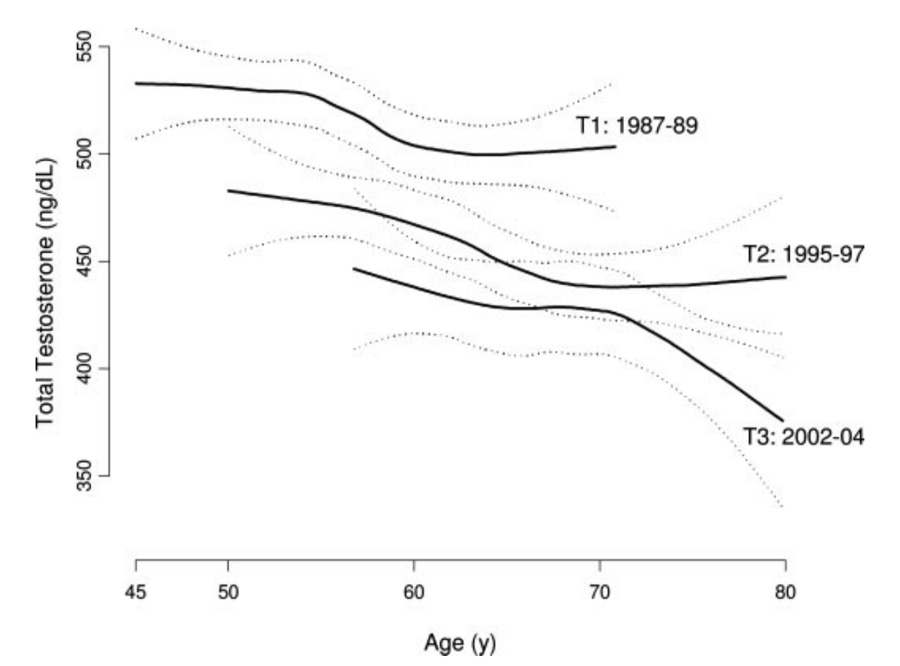
A 40-year-old man today has measurably less testosterone than his father had at the same age. And the trend persists even after you control for obesity, which is the thing that people always bring up as if it explains it away. Something is happening at the environmental level, endocrine disruptors in plastics, contamination in the food supply, sedentary lifestyles, chronic sleep deprivation, that is chemically degrading the male hormonal profile. The men aren’t just culturally weaker. They’re biochemically weaker. The hardware is being corrupted alongside the software.
How the Institutions Tipped
Helen Andrews, Writing in Compact Magazine, put forward a thesis that explains a huge amount of what people lazily call wokeness: everything you think of as woke culture is an epiphenomenon of demographic feminization. Not an ideology or a conspiracy. A predictable consequence of what happens when institutions tip from majority male to majority female.
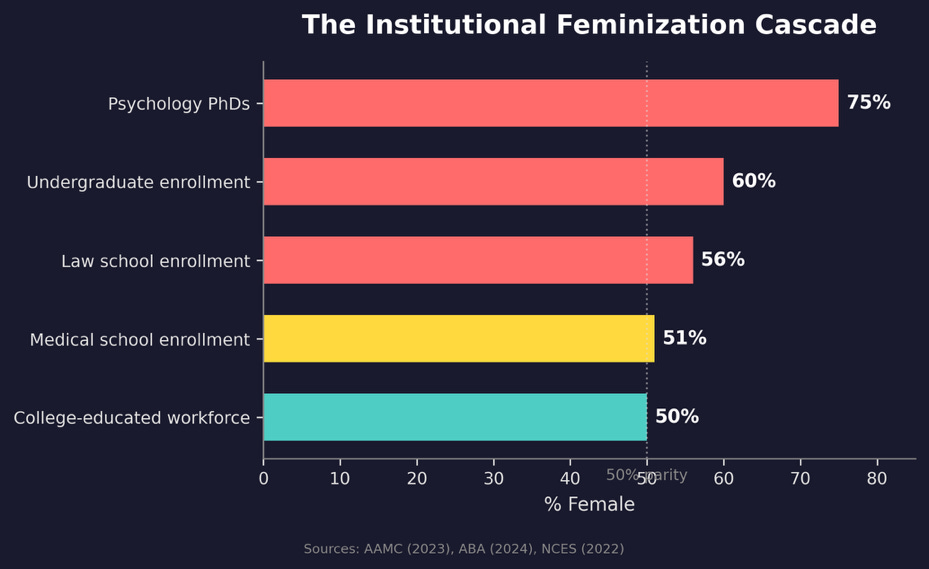
The timeline tells you how it happened. Medical schools became majority female in 2019. Law schools tipped in 2016 and by 2024 they were 56 percent female. Psychology doctorates are now 75 percent female, which is just a staggering number if you think about what it means for the profession that defines mental health for everyone else. Women became a majority of the college-educated workforce in 2019. And Andrews notes that the New York Times newsroom crossed the same threshold around 2018. Once institutions go past parity, they don’t stabilize at fifty-fifty. They keep going. And they keep going because the rules are asymmetric.
Anti-discrimination law makes it illegal for women to be underrepresented. Companies that fail to maintain sufficient female representation face nine-figure lawsuits. Goldman Sachs paid $215 million to settle a gender discrimination class action. Novartis paid $175 million. Nobody has ever been sued for having too few men. Women can sue their employer for maintaining a culture that feels like a frat house. Men cannot sue when the workplace feels like a Montessori classroom. The ratchet only turns one direction.
This matters for relationships because the feminization of institutions didn’t just change who works where. It changed what behaviors are permissible everywhere. Masculine norms, things like direct confrontation, blunt disagreement, tolerance for risk, competitive hierarchy, got reclassified as toxic. Not in some abstract paper that nobody reads, but in actual HR policy and Title IX proceedings and workplace training modules and basically every part of the cultural water supply. The phrase “toxic masculinity” entered mainstream usage and did exactly what it was designed to do: it made men ashamed of the traits that women are biologically wired to respond to.
This is the central irony and it’s worth sitting with. Women evolved to select for strength, competence, decisiveness, the capacity to protect. Research consistently shows that women prefer mates with higher status and earning potential than their own, even when the women themselves earn top-tier salaries. The preference is cross-cultural, showing up in every society that’s been studied. But the culture these women now live in tells them that male strength is threatening, decisiveness is controlling, protectiveness is patronizing. And it tells men that showing these traits is dangerous, professionally and socially. So men suppress them. And women, following what they say they want rather than what they actually respond to, select for agreeableness and emotional availability. And then they’re confused about why they feel no attraction to the agreeable, emotionally available men they selected.
The empathy research clarifies this. Neuroscientist Tania Singer found that female empathy is unconditional: women feel distress when watching anyone in pain, regardless of whether the person deserved what happened to them. Male empathy is conditional: when men watched an unfair player receive a painful stimulus, their empathy decreased and their pleasure centers lit up. This isn’t a deficiency. It’s a feature. Male conditional empathy is what allows men to enforce consequences, punish defectors, maintain cooperative structures through credible threat. Feminized institutions strip this out. What you get is a culture where consequences disappear, where defection goes unpunished, where weakness doesn’t get selected against anymore. Comfort without consequence. And then everyone wonders why nothing works.
The Halo 3 voice chat study showed the status hierarchy dynamics playing out in real time. Lower-skilled male players directed hostile comments toward female-voiced players, while higher-skilled players were supportive. The interpretation is straightforward: men whose position in the hierarchy is secure can afford generosity. Men whose position is precarious see female presence as an additional threat. This maps onto the same pattern you see everywhere else. The men who attack women for getting PhDs or entering male-dominated fields tend to be men whose own status isn’t impressive. But the fact that this hostility is growing tells you that more men feel low-status than a few years ago, which is exactly what the data on economic displacement and sexlessness and social isolation would predict.
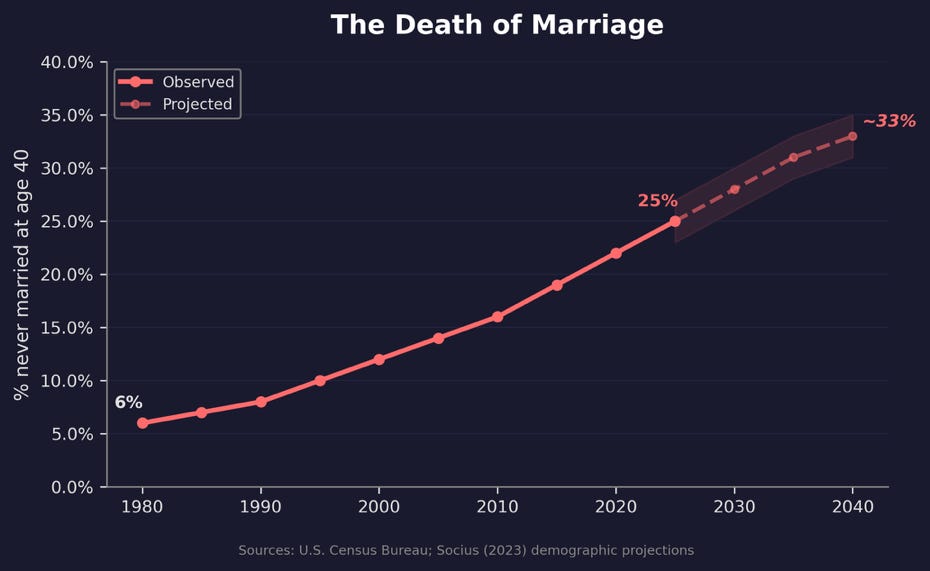
The economic dimension made all of it worse. The marriage rate in the US has declined 54 percent since 1900. One in four Americans who reach age 40 has never been married, which is up from six percent in 1980. New demographic projections suggest that one in three of the young adults alive today will never marry at all. These are not cultural preferences expressing themselves. These are structural outcomes of the system that we built.
When blue-collar work vanishes, men become less marriageable. This is documented and the mechanism is simple: women select for providers. When men can’t provide, women don’t select them. They don’t lower their standards. They opt out of the market entirely, or they choose from a shrinking pool of men who still clear the bar, which intensifies competition at the top and leaves a growing number of men at the bottom with no realistic path to partnership.
The pink-collar shift made it all worse. When factory work gets replaced by home health aides, social workers, and office assistants, the displaced men don’t slide into those roles. The new jobs pay less, carry less status, and are culturally coded as women’s work. A man working as a home health aide doesn’t trigger the same response in women as a welder or a machinist. The economy swapped jobs that made men marriage material for jobs that don’t, and then everyone acted surprised when fewer people got married.
One popular narrative says that if men just did more housework and childcare, women would be more willing to have kids and fertility would recover. The data takes that apart pretty cleanly. Across Western nations, fathers have been doing progressively more housework and childcare with each passing generation. Fertility has continued to fall regardless. The original claim was based on cross-sectional data that got given a causal interpretation it didn’t support. The reality is that female fertility decisions are driven by mate quality, economic security, and ideological framing. Telling men to do more laundry won’t solve the fertility crisis. But it makes for a comforting op-ed, which is the point.
How Ideology Locked the Trap
Every disruption above could have been absorbed alone. Technology warped the market, but markets adjust. Pornography hijacked the reward system, but brains can be recalibrated. Feminization captured institutions, but institutions can be reformed. Economics destroyed male marriageability, but economies can be restructured. What made the damage permanent, or at least generational, was the ideological framework that prevented anyone from naming the problem.
Contemporary institutional feminism told women that their evolved instincts were internalized oppression. If you wanted to be led, that was weakness. If you wanted to nurture, that was just conditioning. And if you found yourself drawn to a strong, competent, protective man, well, that was patriarchal programming and you should probably unlearn it. Women were told to want independence, career achievement, sexual liberation, and to view motherhood with suspicion. Motherhood got rebranded from the most powerful thing a human body can do into a career interruption, a loss of identity, a sacrifice rather than a fulfillment. Watch what happens when a woman announces a pregnancy at a social gathering. Men respond with genuine excitement, share stories about their own kids. Women respond with polite smiles and change the subject, or, increasingly, with something that sounds like condolences disguised as concern. For decades women have been taught that a child ends their life rather than beginning the part of it that matters. The ideology succeeded in making its adherents miserable, which is what always happens when an ideology contradicts biology.
The sunk-cost problem now prevents anyone from defecting. A woman who spent her twenties and early thirties pursuing career advancement under feminist assumptions faces an enormous psychological cost in admitting the framework was wrong. Every year she delayed family formation on ideological grounds becomes evidence of a mistake she can’t afford to acknowledge. So she doubles down. She tells younger women to do what she did. The cycle perpetuates, and it doesn’t perpetuate because it works. It perpetuates because admitting it failed is too expensive.
Meanwhile what the ideology offered men was nothing but contradictions. You were supposed to be strong but not in a way that anyone could call toxic. Sensitive, but not so sensitive that you came across as weak. Ambitious, but not so ambitious that women felt threatened by you. Approach women, but only if you’re already certain she wants to be approached, and even then she might decide retroactively that she didn’t. The consent framework in its most extreme form turned every sexual encounter into a potential criminal liability. Romance requires uncertainty and spontaneity and escalation. The culture demanded certainty and documentation and explicit verbal agreement at each stage. This didn’t make sex safer. It made courtship impossible for the men who actually cared about getting it right. And then the culture complained about the quality of men who were still willing to approach.
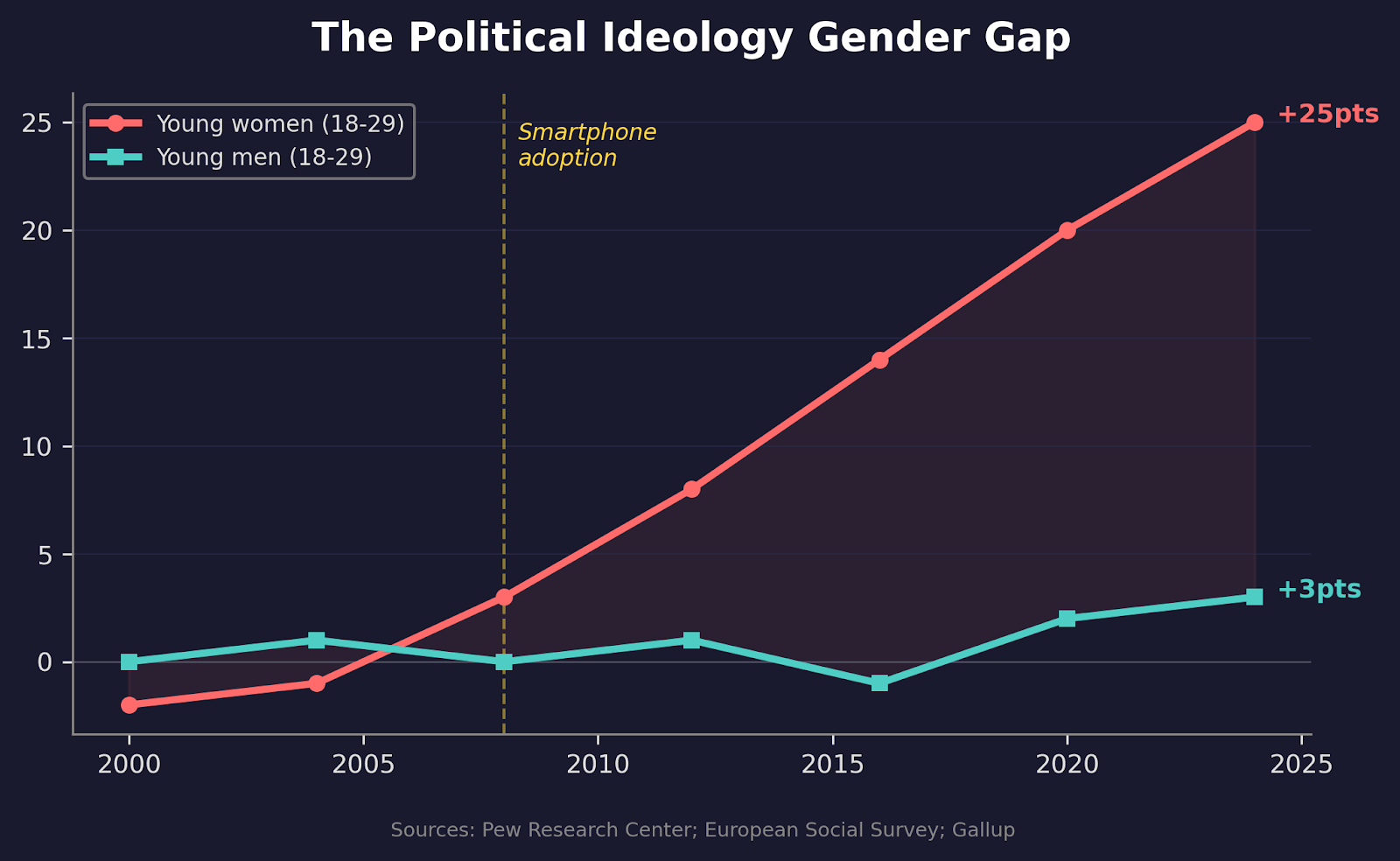
The global political divergence between young men and young women is the measurable output of all this. Across nearly every Western democracy that has been studied, the United States, the UK, Germany, Australia, Canada, South Korea, Poland, and others, the gender gap in political ideology has roughly doubled in a single generation. Young women shifted significantly leftward. Young men barely moved. The acceleration starts around 2007-2008, which is precisely when smartphone adoption went mainstream. Social media functions as a consensus engine, and women, who evolved higher sensitivity to social exclusion because pregnancy and nursing required tribal acceptance, are more susceptible to consensus pressure. The platforms aren’t politically neutral infrastructure. They’re selection environments that capture the psychologically susceptible more effectively than the resistant.
Universities amplified the effect. They flipped to 60 percent female while simultaneously becoming progressive monocultures. A young woman who enters a 60 percent female university where every professor and administrator and orientation leader affirms a progressive worldview exits four years later with her political identity hardened into bedrock. A young man in the same environment learns that silence is safer than speech. The Cato Institute found that the most educated Americans were the most afraid that their political views could cost them their careers. Among Republicans with post-graduate degrees, 60 percent reported this fear, compared to 25 percent of Democrats. The asymmetry isn’t in who holds opinions. It’s in who can say them.
Single women vote more left than married women, and the reason is that single women tend to interact with the government as something that provides for them rather than as something that takes their money. As marriage declined, the female political constituency shifted leftward, wanting more government services and more regulation and more intervention in how things are run. This created a self-reinforcing loop: the ideology that discouraged marriage produced more single women, who voted for policies that further discouraged marriage, which produced more single women. The trap locked tighter with each election.
You can see the outputs everywhere you look. The situationship replaced the relationship. Pledges of fidelity turned into something to dodge, delay, renegotiate forever. The forever boyfriend became a recognizable type: a man who gives all the functional benefits of a partner, the company, the emotional work, the sex, without the structural bond that would make him a husband or a father. Women went along with it because the culture said settling down was a cage. Men went along because the culture said loyalty was optional. Both sides ended up with exactly what the incentive structure rewarded, which turns out to be nothing that holds up over time.
Looksmaxxing, the obsessive pursuit of physical appearance through skincare routines and cosmetic procedures and surgical modification, is the most visible symptom of feminized male competition. For three hundred thousand years men competed through competence and strength and demonstrated capability. Now they compete through aesthetics, which is historically how women competed with each other. Men adopted female competitive strategies because the culture told them that male strategies were toxic. The result is men spending hours on skincare routines while their grandfathers built houses.
The language is a tell. Incel vocabulary has bled into everyday speech. Words like chad, pilled, maxxing, rizz, and mog started in fringe forums populated by men who couldn’t get laid. Now fourteen-year-olds on TikTok use them without knowing where they came from or what they originally meant. When an entire generation borrows its vocabulary for attraction and status from the lexicon of sexual failure, that’s not a subculture phenomenon. That’s a civilizational one.
Women want adoration, to feel cherished, protected, chosen above everyone else. Men want admiration, to feel respected for what they can do, what they’ve built, what they’re capable of. In a working relationship, each person gives the other what they need most. Without those relationships, both needs go starving. Women chase social media validation instead, which is a watered-down version of being genuinely loved by someone who actually knows you. Men chase pornography and video games, which are a watered-down version of being genuinely respected for something real. None of it works. All of it makes money for the platforms that sell it.
Why It Probably Won’t Reverse
The comfortable position is that all of this is cyclical. That the pendulum will swing back. That strong men will emerge from hard times and they will rebuild the thing that was lost. I understand why people find that framing appealing. I don’t think it’s right.
Technology doesn’t unscale. You can’t un-globalize the mating market any more than you can un-invent the printing press. The smartphone isn’t going away. Social media isn’t going away. Dating apps will continue to exist and will continue to make money from the dysfunction they create. The information asymmetry that previously bounded hypergamy, the fact that a woman couldn’t know about a higher-status man three cities away, has been destroyed permanently. Every woman with a phone now has access to the global distribution of male quality, and her reference point has shifted. This can’t be reversed by cultural messaging or individual willpower.
Institutions that have tipped majority female won’t tip back without legal reform, and legal reform of this magnitude takes decades and requires political will that doesn’t exist right now. Anti-discrimination law is a one-way ratchet. The thumb is on the scale, as Andrews put it, and removing it requires first admitting it’s there. We are nowhere near that admission. And the people who are most capable of articulating what’s happening are the ones who are most professionally vulnerable if they try. The Cato survey found that 60 percent of Republicans with post-graduate degrees are afraid that saying what they actually think could cost them their careers.
On top of all that, the algorithmic capture of attention is self-reinforcing. Social media platforms are built to maximize engagement, engagement is driven by emotional arousal, and the platforms will continue to amplify whatever generates the strongest emotional response, which means they’ll continue amplifying grievance and fear and outrage and victimhood. The information environment that radicalized young women leftward and young men into isolation wasn’t an accident. It was an emergent property of attention economics, and it will keep going for as long as attention is what gets monetized.
The trust deficit between the sexes has become self-sustaining. Women don’t trust men because the men they encounter on dating apps are either desperate or performative. Men don’t trust women because the culture has demonstrated that any interaction with women can become a career- or life-ending public event. Each side’s distrust validates the other side’s behavior. This is a Nash equilibrium. Neither side benefits from disarming unilaterally. And no external authority has the credibility or the power to reset the terms.
And the fertility consequences are already locked in. The share of Americans who have never married has reached historic highs, and the birth rate has been declining since the ‘60s with no sign that it’s going to reverse. The women who delayed having children into their late thirties on ideological grounds face biological constraints that no policy can override. Eggs don’t care about your career timeline. Fertility doesn’t wait for social constructs. The women who followed the prescribed script and are now past their fertility window represent a permanent demographic loss. Their potential children will never exist. This isn’t a solvable problem. It’s a consequence that has already happened.
I say this not to make anyone despair but to clear the ground of false hope. The people waiting for the culture to fix itself, for policy to be reformed, for dating apps to become ethical, for feminism to correct course, they’ll be waiting for the rest of their lives. The system-level solutions are real (relationship-oriented platforms rather than engagement-maximizing ones, legal reform to remove the ratchet, smaller communities with thicker relationships, stronger social enforcement around fidelity), but they operate on generational timescales. You don’t have a generation. You have one life. And it’s happening now.
The Only Variable Left
Everything above was a diagnosis. If you read all of it waiting for the part where I hand you a solution, you are the problem I just spent five thousand words describing.
There is no solution. Not at the system level. Not in your lifetime. The dating apps won’t become ethical. The universities wont reform. The legal ratchet wont reverse. The political loop won’t break. Nobody is coming to restructure the mating market so that average men get a fair shot again. That contract is dead. Mourning it is a waste of the time you don’t have.
What remains is what has always remained when the structure collapses: individual selection. Most won’t make it. I don’t mean that as a motivational trick where you read it and think “but I will.” I mean the base rate is failure. The contract that governed mating for three hundred thousand years was built on the premise that most men had a chance if they put in the work. Without that contract, most men don’t. The Paleolithic wasn’t kind to weak men either. The harshness isn’t new. What’s new is that it came back after a brief stretch of comfort that everyone mistook for how things would always be.
Naval broke the inputs down to three: intelligence, opportunity, and agency. Look at what happened to each one.
Intelligence (meaning access to knowledge, not IQ) is free. Your grandfather couldn’t learn a skill without finding someone willing to teach him, couldn’t access a paper without a university library card, couldn’t hear how a successful person actually thinks unless he happened to know one. You have all of human knowledge on a device you carry in your pocket. Every skill, every discipline, every framework, every mistake anyone ever documented. The information asymmetry that used to separate who succeeded from who didn’t has been almost completely eliminated. If you don’t know something today, it’s because you chose not to learn it. That’s a harder sentence to sit with than it sounds.
Opportunity is harder. Some of it is genuine luck, being born in the right place, knowing the right person, catching the right wave. And some people get locked out by systems designed to exclude them (I spoke about several of those systems above, they are real, and acknowledging them doesn’t exempt you from anything). But opportunity has a substitute that isn’t perfect but is functional, and that’s persistence. The man who applies to a hundred jobs after ten rejections operates on a different probability curve than the man who applies to ten and goes home. The man who approaches fifty women after twenty say no is playing a different game than the man who got rejected twice and decided the market was broken. Persistence isn’t a guarantee. It is a multiplier on whatever luck you do have, and over a long enough timeline it starts to look like luck itself.
Which leaves agency. The only scarce resource. The only one the system can’t give you and can’t take from you and can’t fake for you. Intelligence is everywhere. Opportunity is either there or you can brute-force a version of it. Agency is what almost nobody has.
And agency is the simplest thing to describe and the hardest thing to do. It is this: wake up and do the thing. That’s it. Stop planning. Stop optimizing your approach. Stop reading one more article about the problem (including this one). Stop consuming content about self-improvement as a substitute for improving. Stop performing your suffering for an audience that can’t help you. Stop caring about the opinions of people you wouldn’t trade places with. Stop complaining.
The entire system I described, every mechanism, every captured institution, every addictive algorithm, is designed to keep you in a state of passive consumption. Scrolling, swiping, watching, paying. The ideal consumer from the system’s perspective is a man who spends money on dating app boosts and OnlyFans subscriptions and parasocial relationships with streamers who will never know his name. A man who stays weak. Because weak men are profitable. Your loneliness is the raw material, your attention is the product, and your money is what drops out the other end.
Agency means refusing to be the raw material. It means deleting the apps because a 0.6 percent match rate is not a dating environment but a monetized humiliation ritual. It means cutting the porn because you’ve trained your reward system on stimuli that don’t exist and now, you’re confused that reality doesn’t hit the same. It means going outside, in the real world, into repeated contact with actual humans, because how relationships actually form (proximity, repeated exposure, shared activity) hasn’t changed just because your phone has. It means approaching women and getting rejected and approaching again, because the skill of dealing with rejection was something your great-grandfather never needed to build since he already knew everyone in his village. You don’t live in that village, so you have to build it like any other skill, and it will cost you comfort, and that’s what competence has always cost.
It means becoming somebody worth choosing. Not through dating hacks or jaw surgery or a better skincare routine but through the thing women have been selecting for since the species began: demonstrated competence, proven reliability, the visible evidence that you can build and protect something real, a body built with discipline.
None of this is complicated. All of it is hard. If you can’t feel the difference between those two things, nothing I wrote here was for you.
If you came to this essay hoping the answer would be handed to you, that I would name the five steps or the framework or the morning routine that fixes the broken contract, or give you the “how to change your life in one day”, without first accepting that you have to work harder than the men who came before you in a system less forgiving than the one they had, with no guarantee it works out, then I genuinely don’t know what to tell you. The men who survive this transition will be the ones who treated the collapse as a selection event they intended to pass. The rest will keep reading essays about why things are broken, and agreeing with every word, and doing nothing.
Join the fight for the Soul of our Civilization!
By subscribing to Atlas Press, you are supporting an honest group of guys who are working to help revitalize Western Civ through the re-enrichment of the Western mind. We appreciate your support greatly.
You didn't mention the generation of boys in the 90s that were plagued by "ADHD" because female teachers and schools couldn't handle natural male output. So they pumped them full of pills to keep them in line.