


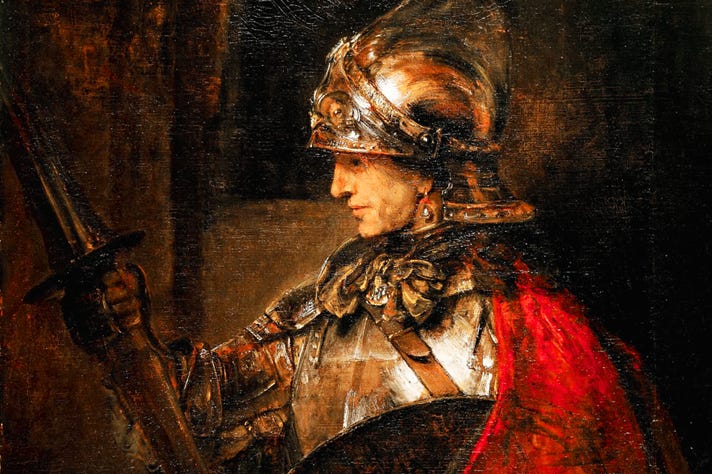
Modern culture quietly assumes that excellence is the sum of discipline, efficiency, and competence. If that were true, then history would be filled with legends about administrators: men who kept empires running, solved problems, executed plans, and held everything together through sheer reliability.
But it isn’t.
Those lives end the same way: A final project completed, a brief applause, and a swift disappearance into memory. Meanwhile Alexander the Great died at thirty-three, and the world immediately began telling stories about him. Stories so strange and extravagant that modern readers dismiss them as fantasy: Alexander rising toward heaven, speaking with prophetic trees, and glimpsing the structure of the cosmos.
Why him? Why not the countless disciplined, intelligent men who built the systems Alexander used?
This is where the modern mind hesitates. Because answering that question forces us to confront something we rarely consider anymore. What a legend really is, and why we stopped reading them.
In this essay we look at the legends surrounding Alexander not to analyze his life, but to understand something larger: Why do legends arise at all, and what truth have we forgotten because we no longer read them?
Reminder: you can get tons of useful members-only content and support our mission for a few dollars per month 👇
Two full-length, new articles every single week
Access to the entire archive of useful knowledge that built the West
Get actionable principles from history to help navigate modernity
Support independent, educational content that reaches millions
Why Caesar Wept
Plutarch tells us that at thirty-one, Caesar stood before a statue of Alexander and wept. He was not comparing strategies, supply lines, or administrative skill. He was grieving something deeper: That Alexander had manifested a world-shaping pattern he himself had not yet entered.
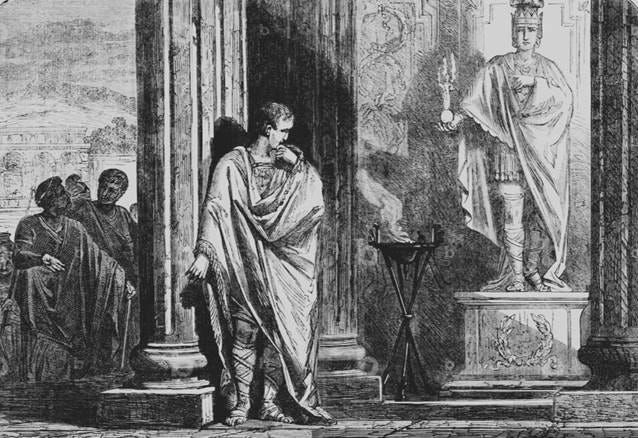
Alexander’s legend preserved exactly what Caesar felt. It distilled the essence of a life that expanded human possibility to its furthest edge. And that is why legend matters. Not because it records events, but because it preserves the form of greatness that isolated events often hide.
To see this clearly, we must look at one of the most memorable scenes from Alexander’s legend…
Facts or Pattern?
One of the oldest stories about Alexander tells of his attempt to ascend into the heavens. In the medieval and late antique accounts, he harnesses griffins to a platform and holds pieces of meat aloft on spears to lure them upward. The griffins beat their wings furiously, lifting him toward the sky. But as he rises, a force stops him. He cannot go further. He is turned back.
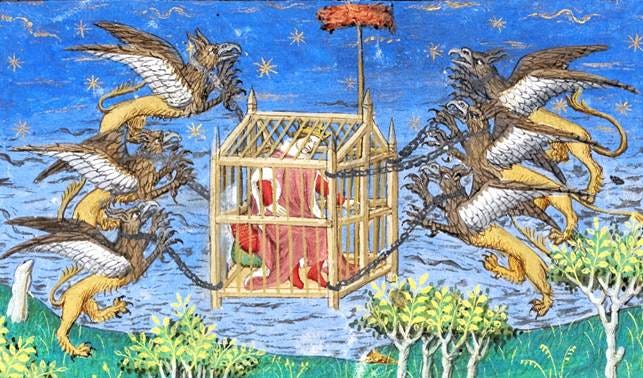
Versions differ, but the core image remains: a man is lifted upward until he reaches a boundary he cannot break. This scene was not created as entertainment. It is how ancient storytellers expressed the meaning of Alexander’s life.
Here is the crucial point:
Facts describe what happened once.
Patterns show what a life was ultimately moving toward, its purpose.
If you list the facts of Alexander’s life one by one, the dates, the battles, the miles marched, you end up with a fragmented record. Nothing in that list tells you what his life revealed or why it mattered. It is “accurate,” but it does not give you the truth of his life.
Contrary to the modern instinct, facts are not more true than patterns. They are less true, because they strip away the unity that gives a life its shape. The legend, by contrast, remembers the pattern Alexander’s life enacted: A human being rising to the furthest edge of possibility and discovering that the highest threshold cannot be crossed by force.
The griffin story expresses that purpose more directly than any chronological record could. It condenses the entire arc of his life into a single image that reveals the structure behind it. This is what legend preserves. Not the factual details of action, but the pattern that makes the actions worth remembering.
How to Distinguish Legendary from Ordinary
As shown above, legends form around pattern-embodiment, not around ordinary competence.
A man may accumulate wealth, power, and prestige, and still vanish from memory within a generation. His accomplishments were real, but they revealed nothing about the deeper order of the world. He is like the man we met in the opening: Admirable, disciplined, but forgettable.
But when someone’s life aligns with a fundamental structure (when it makes visible how ambition, courage, sacrifice, or limit work) stories gather immediately. The stories elaborate, intensify, and take on archetypal form. Not because people are lying, but because they are trying to mark what they witnessed.
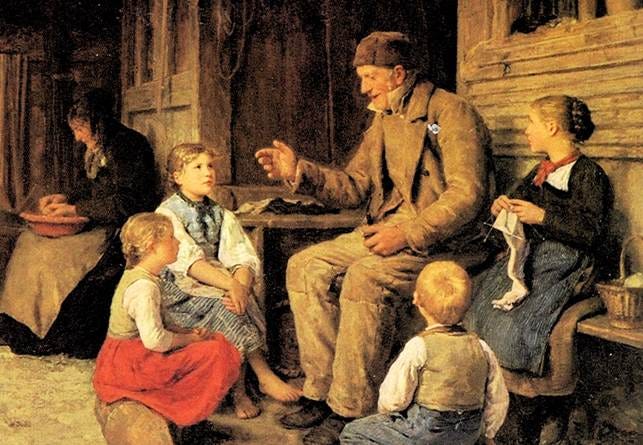
Think of how people speak after someone dies. If the stories grow sharper, more symbolic, more patterned, you encountered greatness. If they merely recite accomplishments, you witnessed competence. Today we rarely notice this distinction anymore, and that is why we no longer find value in the legends we inherited.
What This Means for You
The purpose of reading legends is not to escape reality but to learn how to perceive it. Legends restore a form of sight modernity has nearly lost: the ability to see truth at scale, the underlying structures that shape human life.
They teach you to recognize when someone is not merely succeeding but embodying something.
They help you understand your own direction and the pattern of your own life.
They show you how to see yourself not as a sequence of tasks, but as participation in a pattern.
And they confront you with a final question: Are you participating in any pattern larger than yourself, or merely running efficiently inside a very small frame?
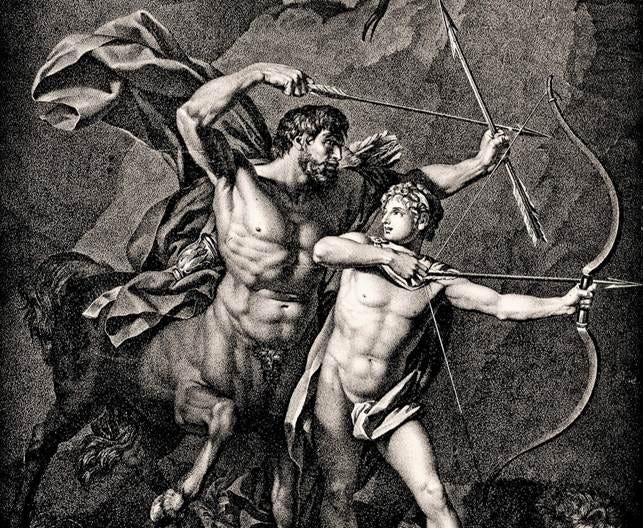
By preserving our legends, we are not being naïve. We are acknowledging that without them, a civilization loses the ability to take aim and see truth at scale. Truth has not disappeared. We have simply forgotten how to read it, and legends teach us how to read it again.
Some men became myth because they embodied truths greater than themselves. That possibility has not disappeared. It has only been forgotten, and remembering it may be the first step toward becoming more than we thought possible.

This is a work of genius.
Excellent piece here, this work is unique and important. People forget how important myth and legends are, too fixated on the facts and figures instead of understanding the metaphors and patterns.