
Traitors: The Greatest Enemy Within
Better are the wounds of a friend, than the deceitful kisses of an enemy...


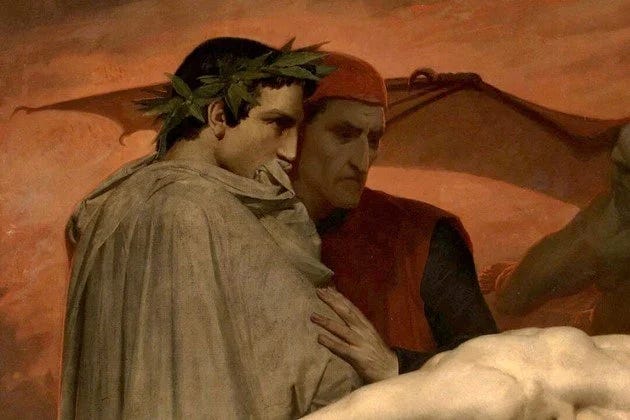
Civilizations don’t always collapse because their enemies are strong. They collapse because their own people grow weak, and weakness is a civilizational liability. When virtue is abandoned and vigilance fades, corruption slips both through the city walls and into the hearts of men—not as an invader but as a welcomed guest. It is ushered in by the traitor, the one who opens the gates and delivers friends into the hands of their enemies.
In his History of Rome Titus Livius captured this dynamic with brutal precision, writing that the greatest enterprises are destroyed “not by open force” but “by treachery… which is the cause of ruin.” Decay begins quietly, in the softening of the austere spirit that follows comfort and luxury, until it gathers into a decisive moment capable of radically altering the course of history. In such decisive moments, the archetypal traitor emerges. Where loyalty, sacrifice and fidelity are demanded, the traitor is duplicitous, opportunistic, and self-preserving, and in doing so embodies Plato’s moral axiom that “the greatest wrong is to harm one’s friends and help one’s enemies.”
The traitor is therefore not merely a danger to himself but a danger to society, since his weakness becomes contagious, destroying others in the very act of destroying himself. His treason fractures the bonds that hold families and friends together and accelerates the race to the bottom in which loyalty becomes a commodity to be priced, traded, and sold to the highest bidder. And once treachery becomes contagious, it no longer appears as an aberration but as a pattern — one that recurs with grim regularity in the pages of history.
For this reason, treason is not merely a private moral failure but an anti‑political act in the strictest sense. Every society rests on a fragile architecture of trust — trust between citizens, between rulers and ruled, between families, allies, and institutions. The traitor annihilates that trust, a truth made evident in the three infamous archetypes: Judas Iscariot, the traitor to faith; Ephialtes, the traitor to the fatherland; and Brutus, the traitor to the family.
Reminder: You can get tons of members-only content dedicated to useful knowledge, and support our Mission at the same time for a few dollars per month 👇
Two full-length, new articles every single week
Get actionable principles from history to help you navigate modernity
Access to the entire archive of useful knowledge that built the West
Support independent, educational content that reaches millions
Why the Traitor is Universally Despised
Dante Alighieri understood with poetic and theological precision what civilizations have long intuited, namely, that the traitor is the most destructive of all sinners and treason is the most destructive of all vices.
In the Inferno of his Divine Comedy, Dante places traitors in the deepest circle of Hell, not in fire but in ice — immobilized, silenced, and entombed in a frozen lake. This is no arbitrary punishment. Ice is the perfect image of a heart in which charity that sustains both human relationships and human societies has grown cold. The traitor’s sin is not the result of impulse or passion but of a calculated betrayal, and thus, he is punished not with the fires of hell which consumes, but with cold, which isolates, hardens, and kills — a mirror to his own heart.
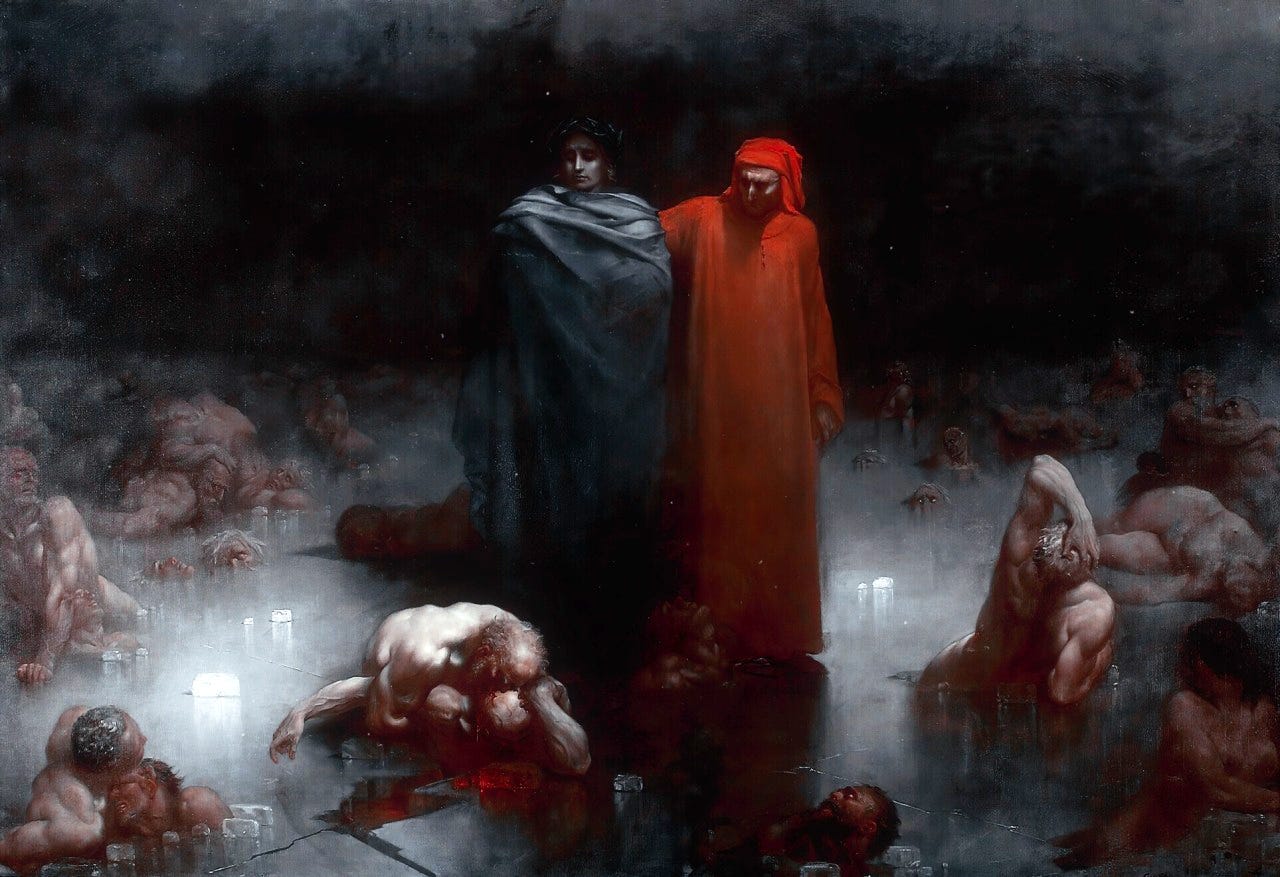
Whether one believes in an afterlife or not, Dante’s moral architecture reflects a deeper poetic justice: Hell is not merely a physical place but a state where one’s eternal punishment is in accordance with and proportionate to the vices one commits on earth.
Judas Iscariot: Traitor to the Faith
Judas Iscariot stands as the archetype of the traitor to the faith — one who betrays not from ignorance but from a heart disordered by desire. His treachery is uniquely grievous because it unfolded in the full light of revelation since he had walked with Christ, witnessed His miracles, and broke bread with Him. And yet, Judas chose to deliver the Son of Man into the hands of His enemies for thirty pieces of silver.
The kiss in the Garden of Gethsemane has entered the Western imagination as the defining gesture of betrayal because it turned an act of affection against the One to whom it rightfully belonged. In response, Jesus’ rebuke — “Judas, dost thou betray the Son of Man with a kiss?” — cuts deep into the heart of every traitor to the faith who would follow, for they too distort the signs of devotion into the very acts that deliver the innocent to death. As St Augustine observed, “the worst of all wounds is the wound of a false friend,” a truth Judas embodied with chilling clarity.

Titus Livius wrote that “the gods themselves are hostile to the faithless,” a judgment that echoes the ancient conviction that treachery violates not only human bonds but the very structure of reality. This is why the ancients spoke of treachery as nefas est — a thing forbidden not merely by law but by nature itself. Nefas names an act so contrary to the grain of the world that it tears at its fabric, and is the violation of a sacred trust, a profanation of the bonds that hold heaven and earth in harmony. To commit nefas is to place oneself outside the moral universe, to stand in opposition to the very order that sustains life.
Judas therefore reveals the archetype of the traitor to the faith, the disciple who ceases to love what he claims to serve.
Ephialtes: Traitor to the Fatherland
If Judas represents betrayal of the divine, Ephialtes of Trachis represents betrayal of the fatherland. His name endures as a byword for treachery because it was Ephialtes who revealed to the Persian invaders the hidden path around Thermopylae, allowing them to outflank and overwhelm the Spartan‑led defense. As Herodotus records, “For this deed the Greeks declared Ephialtes a traitor, and his name has been held in infamy ever since.” His motive was neither complex nor noble but was the pursuit of personal advantage and self‑preservation at the expense of his own people.
Thermopylae was more than a narrow pass. It was a symbol of Hellenic resolve — a stand for the freedom of Greece against the advance of foreign imperial power. By guiding the invading army, Ephialtes imperiled not only a small band of defenders but the cultural inheritance of an entire civilization. Ephialtes reveals the archetype of the political traitor, namely, one who abandons loyalty when it involves sacrifice.
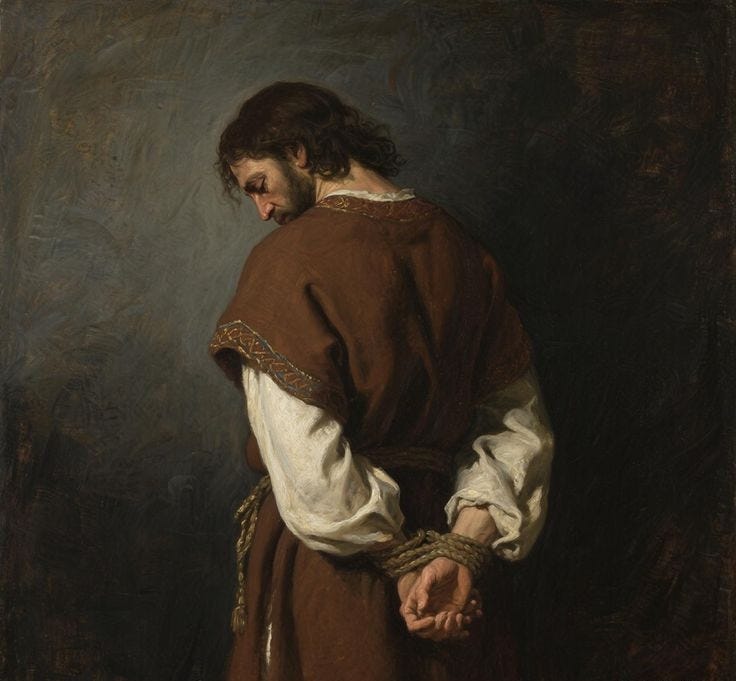
In his Histories, Polybius wrote that “Nothing is more dishonorable than a man who betrays his friends or his country”. Civilizations can endure invasions and loss of tens of thousands of men in a single battle, but they inevitably collapse when one man chooses to undermine the bonds of trust upon which society depends. For this reason, Ephialtes’s treachery remained a permanent warning in Greek memory — that the greatest danger to any city is not the thousands of enemies outside the walls but the one traitor within.
Ephialtes therefore reveals the archetype of the traitor to the fatherland, the citizen who refuses to protect his homeland.
Brutus: Traitor to the Family
If Judas represents betrayal of the divine and Ephialtes betrayal of the fatherland, Marcus Junius Brutus represents betrayal of the family. His place in history is more contested, yet his treachery remains one of the most infamous. To some, he was a defender of Roman liberty and to others, a parricide. What is beyond dispute, however, is that he violated the deepest natural bond — the bond between a father and son.
Brutus’s relationship with Julius Caesar was not merely political. Caesar had shown the young Brutus unusual favour, advancing him to positions of trust and treating him with a near‑paternal affection — a closeness that many Romans linked to Caesar’s reputed relationship with Brutus’ mother, Servilia. As a result, Brutus’ role in Caesar’s assassination is all the more tragic.
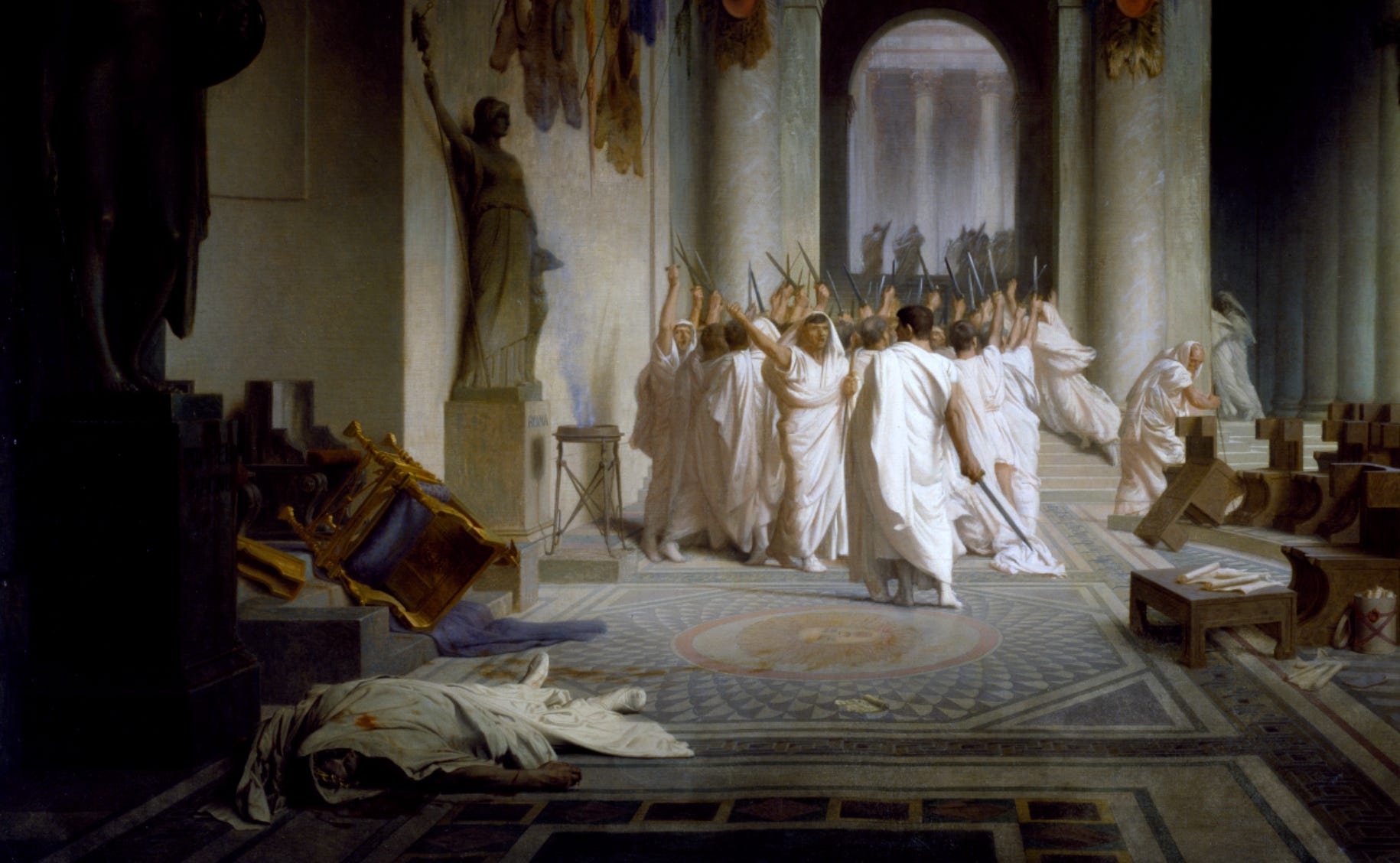
On the Ides of March, Caesar entered the Senate and, as he took his seat, the conspirators closed in around him under the false pretense of petition. Suddenly, Steel flashed beneath their togas, and the first strike fell quickly escalating into chaos as each senator drove their blades into the unarmed dictator. Amid the frenzy, Caesar struggled to rise, bloodied and bewildered, until he saw Brutus emerge from the circle of attackers. In that moment of tragic realization, Caesar uttered those famous final words, “et tu, Brute” — “and you, Brutus?”. Caesar knew he had many powerful enemies who wished him dead, but he never expected the man he called a son to be a co-conspirator, let alone deliver the final blow.
Brutus’ act inaugurated a cycle of violent civil war that ultimately destroyed the Roman Republic he claimed to defend. The weakness of one man became the unraveling of an entire political system because when familial bonds collapse, the political order soon follows.
Brutus therefore stands as the archetype of the traitor to the family — the son who raises his hand against the man who formed him.
Final Judgment
The figure of the traitor endures because he exposes a truth that civilizations prefer to forget, that decline begins not at the borders but in the soul. Judas, Ephialtes, and Brutus are not merely relics of an ancient past but a reminder that the most devastating ruptures occur when the obligations that bind a people together are treated as negotiable. Their stories reveal that betrayal is never an isolated act but a contagion of the moral imagination, and that once a society learns to excuse treachery in small things, it soon finds itself unable to resist it in great ones.
What these ancient examples ultimately teach is that loyalty is not just a private sentiment but a discipline — a habit of fidelity that must be continuously cultivated, guarded, and renewed. Civilizations do not endure by strength alone but by maintaining the quiet, often unseen obligations that hold the faith, fatherland, and family together.
Join the fight for the Soul of our Civilization!
By subscribing to Atlas Press, you are supporting an honest group of guys who are working to help revitalize Western Civ through the re-enrichment of the Western mind. We appreciate your support greatly and hope you join us.
We ignore these lessons at our own peril.
https://www.justgiving.com/team/shakih-imran-ahmed-3?utm_medium=team&utm_content=shakih-imran-ahmed-3&utm_source=copyLink&utm_campaign=pfp-share&invite=true