
The Family is the Foundation of Civilization
Why weakening the family dooms society


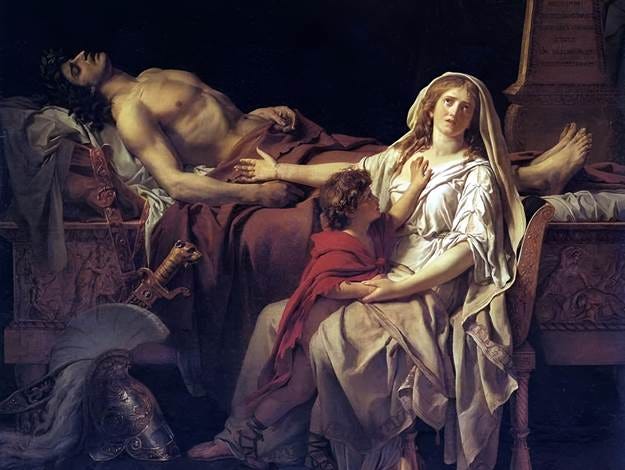
Modern man often treats civilization as an abstract construct—an accumulation of ideas, institutions, and traditions dissolving into a vague ideal. Yet civilization is far more concrete and immediate than we admit, and it ultimately rests on a single, irreducible unit: the family.
The family is the microcosm of civilization itself. It is the first community, the first school of virtue, the first church, and the first arena of governance. From the Roman pater familias to the Biblical household and the Scholastic synthesis of St. Thomas Aquinas, thinkers have long recognized the family as the bedrock upon which every higher social order stands.
To weaken the family is to weaken the very foundation of civilization, a truth confirmed throughout the annals of human history, where the disintegration of the household consistently precedes the decline of the culture built upon it.
Reminder: you can get tons of useful members-only content and support our mission for a few dollars per month 👇
Two full-length, new articles every single week
Access to the entire archive of useful knowledge that built the West
Get actionable principles from history to help navigate modernity
Support independent, educational content that reaches millions
The Family in the Roman World
In his De Officiis, the Roman statesman and orator Marcus Tullius Cicero wrote that “The first bond of society is marriage; next, children; then the whole family”. In this incisive observation, he effectively captured the understanding that the family was not merely a private arrangement but a sacred and civic institution.
At its head of the Roman family stood the pater familias (father of the family), also known as the dominus (lord). He bore responsibility for the transmission of the Mos Maiorum (way of the ancestors) to those within his household which included both the particular customs of the family, but also the general tradition, religion, and civic virtue of the Roman people. It was within the family that the virtues essential to the Republic were first cultivated, and it was within the Roman household that worship itself found its earliest and most enduring form.
The pater familias also presided over the lares and penates, the household gods, ensuring that religion and piety were not isolated acts of devotion but a sacred inheritance passed through generations. To Cicero, religion and piety were inseparable from domestic life, “For what is more sacred than the house of each man? What is more religious than the hearth of each man?”, drawing the connection between the hearth as both an altar and anchor of Roman identity.
Because the hearth was the symbolic altar of civilization, the authority of the pater familias carried both juridical and moral weight. Roman law vested him with patria potestas — the power of life and death over his household and this sacred authority was ordered toward the preservation of Roman tradition. The family functioned as the first school of discipline, where obedience and reverence were learned, and just as the Senate safeguarded the wisdom of the ancestors, the father safeguarded the customs that sustained the household. In this way, the family ensured that civilization was not reinvented with each generation but transmitted as a living tradition from its foundations to the present.
Thus, in Rome, the household formed the foundation of civic order, religion, and law, and without the stabilizing presence of the pater familias, the Republic itself would have risked dissolving into chaos.

 | A guest post by
|