
The Ethics of War: Just War Theory to Realpolitik
A coherent moral vision for warfare


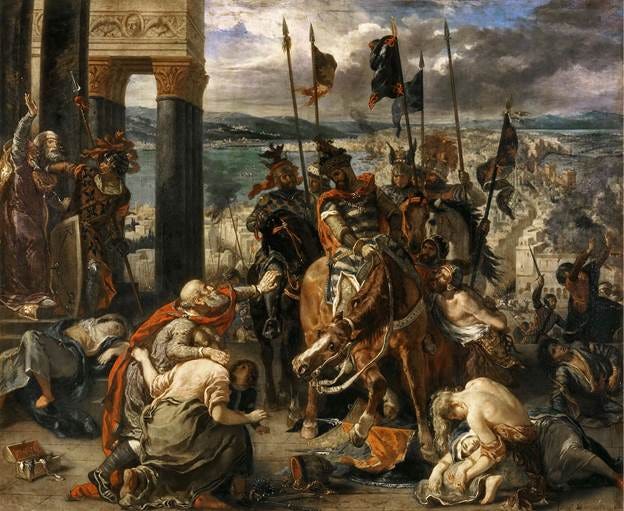
From the earliest centuries of Christian thought, the tension between the call to peace and the persistent reality of war confronted theologians, rulers, and ordinary believers alike. Christ’s Sermon on the Mount, with its blessing upon the peacemakers, set forth an uncompromising ideal; yet Christians lived in a world marked by conflict, political instability, and the need for self‑defense. The question was never merely theoretical. It pressed upon communities and kingdoms that could not survive by moral aspiration alone.
For this reason, the Church long grappled with the problem of whether — and under what conditions — war might be morally justified. The tradition that emerged rejected absolute pacifism. It affirmed that peace is the natural and proper state of human society, but it also recognized that grave circumstances may compel the use of force. When negotiation collapses, when injustice demands correction, and when the innocent face unrestrained aggression, armed resistance may become not only permissible but a moral obligation aimed at restoring order and protecting the vulnerable.
At the center of this intellectual development stands St Thomas Aquinas, whose Summa Theologiae offers the most systematic and enduring account of what later generations would call just war theory. Drawing upon Scripture, the Church Fathers — especially St Augustine — and the principles of natural law, Aquinas distilled the moral logic of warfare into three essential conditions: legitimate authority, just cause, and right intention. These deceptively simple criteria form the core of jus ad bellum, the principles governing the decision to wage war. They reflect a coherent moral vision in which political authority, justice, and charity intersect to guide the Christian ruler in the most consequential of human actions.
Yet the modern world, shaped by nation‑states, ideological conflict, and geopolitical strategy, often treats war less as a moral problem than as an instrument of national interest. In such an environment, Aquinas’s careful moral architecture stands in stark contrast to the calculations of realpolitik, even as the questions he posed remain as urgent as ever.
Reminder: you can get tons of useful members-only content and support our mission for a few dollars per month 👇
Two full-length, new articles every single week
Access to the entire archive of useful knowledge that built the West
Get actionable principles from history to help navigate modernity
Support independent, educational content that reaches millions
Just War Theory
Christianity has never advanced an absolute pacifism. While the Gospel extols peace and commands charity toward all, the Church has long recognized that a fallen world sometimes forces rulers and communities to defend themselves against grave injustice. Out of this tension emerged a moral framework for the use of force — later termed just war theory — which sought to distinguish legitimate defense from mere violence.
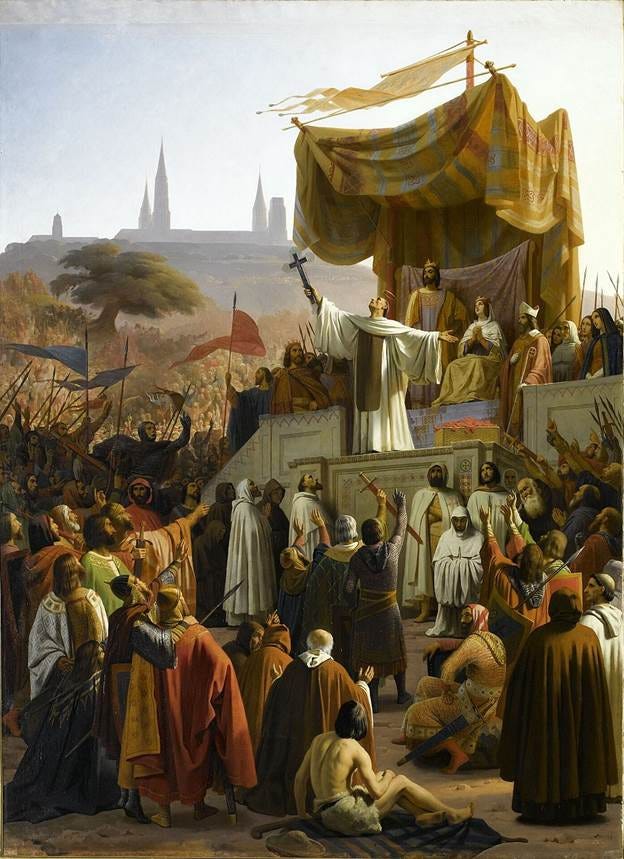
Early Christian thinkers, drawing especially on the insights of St Augustine, identified several conditions that must be met before war could be considered morally permissible — or jus ad bellum. These include a rightful authority to declare it, a just cause that warrants it, and a right intention guiding those who wage it. These principles formed the foundation upon which later theologians, most notably St Thomas Aquinas, would construct a more systematic account of warfare and moral responsibility.

 | A guest post by
|