


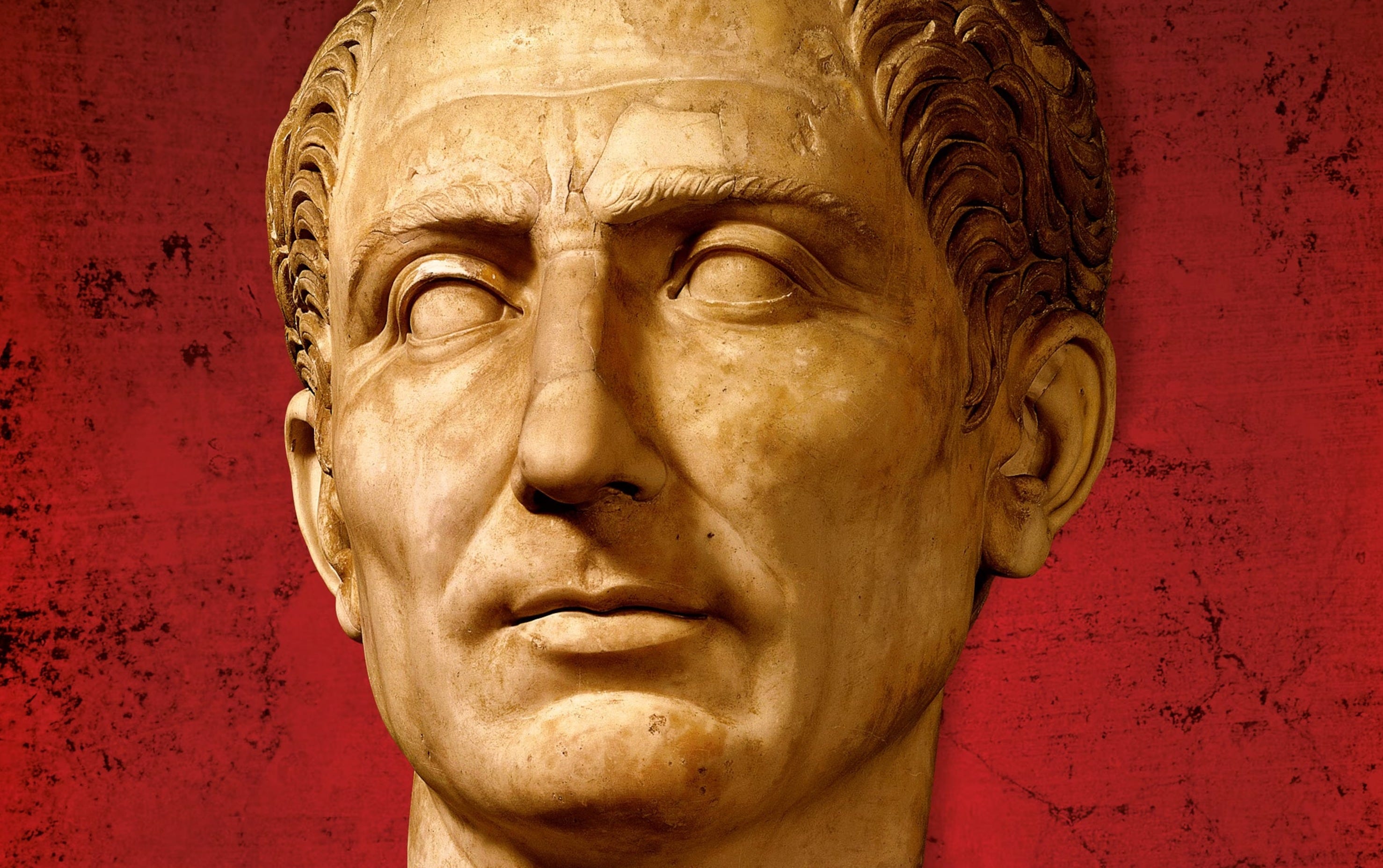
We live in an age of instability.
The social and political forms that once seemed durable now tremble under the weight of accumulated crises. Age‑old institutions that once safeguarded civic virtue and tradition now struggle to maintain relevance, elites quarrel without governing effectively, and the public drifts ever further into disillusionment and fatigue.
The sense of civic coherence that sustained earlier generations has thinned, leaving behind a social and political landscape marked by fragmentation, uncertainty, and a growing suspicion that the existing order can no longer sustain. In such periods, societies begin to search — not always consciously — for a figure who can resolve what their institutions cannot.
History shows what emerges from such conditions.
When instability becomes chronic, when constitutional mechanisms fail to adapt, and when the public grows weary of procedural politics, a singular, decisive figure — a Caesar — appears.
In his Histories, Polybius observed that political orders decay in patterned cycles, noting that “all constitutions have a natural cycle of growth, maturity, and decline.” Civilizations, when they reach certain thresholds of disorder, generate the conditions for a commanding actor capable of imposing coherence where the system can no longer provide it.
Similarly, Oswald Spengler, writing with the fatalism of a cultural morphologist, argued that late civilizations inevitably produce “the Caesar‑type,” a figure who arises when the forms of republican life have become hollow and the people grow weary of — or no longer believe in — the legitimacy of their institutions.
The ten conditions that follow describe the social landscape that makes such a figure possible. These are not psychological traits of the leader or moral judgments about the people, but the structural realities that prepare the ground for the emergence of such a figure.
In the late Roman Republic and post‑revolutionary France, these conditions appeared with remarkable similarity, alternating in their intensity but converging toward the same outcome: the rise of Julius Caesar and Napoleon Bonaparte.
Today, as instability deepens, the same structural forces gather once more.
Reminder: You can get tons of members-only content dedicated to useful knowledge, and support our Mission at the same time for a few dollars per month 👇
Two full-length, new articles every single week
Get actionable principles from history to help you navigate modernity
Access to the entire archive of useful knowledge that built the West
Support independent, educational content that reaches millions
Systemic Political Breakdown
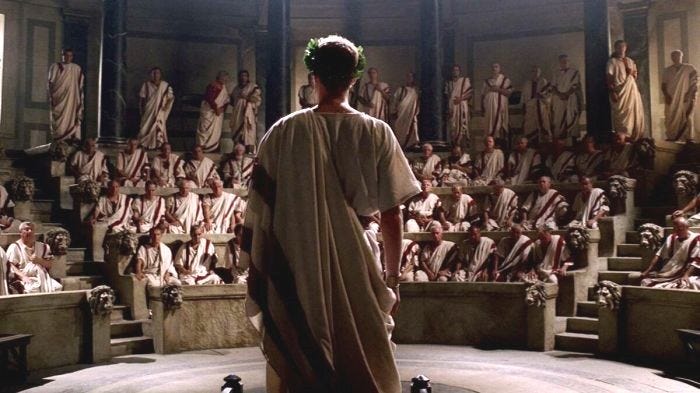
A Caesar emerges first from systemic political breakdown. In Rome, the Republic’s constitutional machinery could no longer translate public needs into coherent action. Yet this breakdown reflected deeper structural fault lines. A political order built for a small, unified city‑state was now straining to govern a vast, culturally diverse empire stretching from the British Isles to the frontiers of Persia.
Rome’s rapid expansion produced chronic paralysis. Magistrates with competing loyalties obstructed one another, assemblies were steered by wealthy patrons pursuing private gain, and the Senate drifted into rhetorical posturing rather than governance. Romans grew accustomed to drift, corruption, and institutional fatigue.
In such conditions, the public begins to tolerate, then entertain, and eventually welcome figures who promise decisive authority. Caesar’s rise must be understood in this light. His crossing of the Rubicon marked the moment when a stagnant system met a decisive force, and both enemies and allies sensed that in an age of paralysis, fortune favors the brave.
Elite Fragmentation and Paralysis
The second condition is elite fragmentation. Rome’s governing class, once held together by Romanitas and the Mos Maiorum, splintered into rival blocs that treated politics as a theatre for personal dominance rather than the guardianship of the res publica.
The deeper trend was the collapse of elite consensus. Senators no longer trusted one another to uphold constitutional norms or restrain private ambition, and partisan hostility replaced cooperation. The Optimates and Populares were less coherent movements than antagonistic patronage networks locked in cycles of obstruction, each more intent on frustrating its rivals than allowing the Republic to function.
So profound was this paralysis that many elites became willing to cast their support behind figures who operated extra‑judicially — outside the traditional legal framework — if such actors promised to break the deadlock and deliver progress.
This partisanship produced paralysis. Legislation stalled, magistrates vetoed one another’s initiatives, and the Senate became incapable of coordinated action or governing effectively.
Caesar rose within this landscape of stagnation. His alliance with Pompey and Crassus — the First Triumvirate — was not merely an innovation but an indictment of the political order itself. It revealed that three men could bypass institutions that no longer governed, stepping around a Senate paralyzed by factional hostility and procedural obstruction.
When elites cease to act, and even begin to tolerate extra‑legal solutions, they create the vacuum in which someone willing to act inevitably steps forward.

Socioeconomic Polarisation
The third condition is socioeconomic polarisation. In post‑revolutionary France, years of upheaval had eroded the economic foundations of society. Inflation hollowed out savings, food shortages undermined confidence, and the uneven recovery after the Terror left the middle classes anxious and the poor desperate.
At a deeper level, the Revolution had produced a more fundamental shift. The social base of republicanism had weakened, and the people no longer believed the existing order could deliver stability or fairness.
Napoleon’s appeal rested on his ability to present himself as a stabilizer. Predictable taxation, protection of property, and financial order were not abstract promises but concrete remedies for a society exhausted by chaos. His consolidation of the Bank of France and stabilization of currency addressed needs that republican institutions had failed to meet.
The pattern is all too familiar. When economic systems fail to provide security, societies become open to actors who promise to restore trust in institutions. Napoleon emerged because France needed stability more than procedure.
Collapse of Institutional Legitimacy
The fourth condition is the collapse of institutional legitimacy. In France, confidence in republican governance had eroded long before Napoleon’s ascent.
The Directory had devolved into an institution unable to govern effectively. Courts issued contradictory rulings, individual ministries became more and more compartmentalized and competed for power rather than operating as a coordinated whole, and the legislature cycled through purges, coups, and reversals that made policy unpredictable. Instead of a functioning unified state, France was governed by fragmented institutions that acted independently, with no common centre of command, and thus, no perceived legitimacy.
Napoleon entered this vacuum as the figure capable of imposing order amid institutional chaos. His Consulate promised uniform laws, stable administration, and a single executive voice after years of fragmentation. Moreover, he reanimated the Republic’s exhausted administrative framework by eliminating redundant bodies, consolidating overlapping functions, and infusing the remaining institutions with renewed administrative vigour, transforming a disordered bureaucracy into a disciplined engine of state power.
When institutions lose operational capacity — not just legitimacy — the public inevitably turns toward figures who can restore functionality. Napoleon succeeded because France needed effective governance, not another rearrangement of republican forms.
Cultural and Moral Disorientation
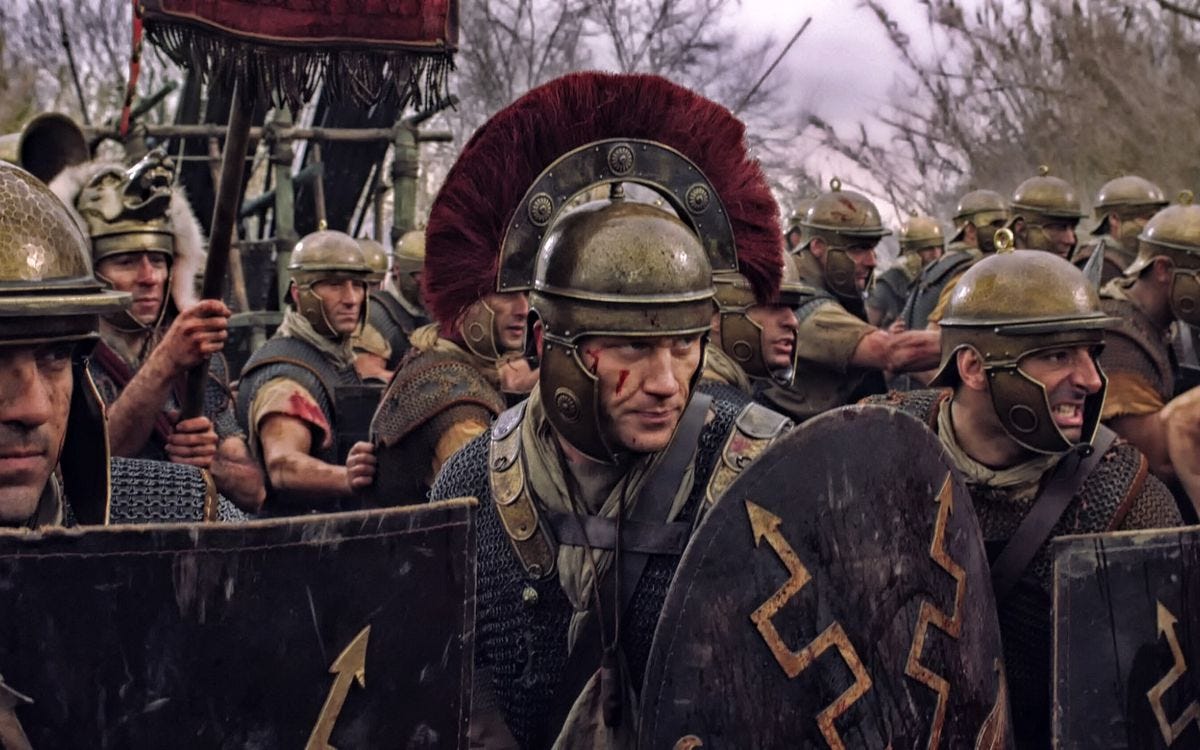
The fifth condition is cultural disintegration. By Caesar’s time, Rome had not only lost political stability but the moral and religious foundations that once shaped its civic identity.
The Mos Maiorum — the ancestral code of duty, piety, and public virtue — had weakened under the pressures of expansion, wealth, and factional conflict. Traditional rites were neglected, civic festivals lost their seriousness, and public life no longer reflected the virtues Romans believed had built their Republic.
As these customs faded, many Romans began to sense that their society had drifted too far from the moral order that once sustained it. The deeper trend was a growing recognition that abandoning ancestral practices had left the Republic spiritually bankrupt.
Caesar emerged as a figure capable of restoring Roman dignity, reviving public religious rituals, honoring traditional gods, and embodying the decisiveness associated with Rome’s past. The Romans longed for a restoration of traditional virtue and religiosity that had once defined them.
Militarisation of Public Life
The sixth condition is militarisation of public life. Rome’s long history of expansion had created a culture in which military success became the primary measure of legitimacy.
The deeper trend was the normalization of martial authority since decades of conflict elevated generals above civilian magistrates. Romans increasingly believed that only military leaders could safeguard the state, manage crises, or defend the empire’s interests.
Caesar’s Gallic victories elevated him because they aligned with this cultural shift. He embodied action, decisiveness, and competence — qualities Romans associated with military command rather than the senatorial class who were prone to endless deliberation and the procedural drift that had come to define late‑Republican politics. When societies become accustomed to crisis, whether foreign or domestic, they often turn toward figures associated with action rather than deliberation.
Caesar rose because decades of crisis had conditioned Romans to see generals as the only figures capable of decisive governance.

National Mythos and the Desire for Unity
The seventh condition is mythic hunger for unity. By the late 1790s, France had endured wars, revolution, terror, factional purges, and bitter ideological conflict. Years of civil strife had fractured the nation into competing visions of what France should be. The deeper force was psychological: prolonged internal division creates a cultural longing for a figure who can bind the fragments together under a renewed sense of national purpose.
Napoleon’s Consulate succeeded because it offered precisely this unifying mythos. He presented a narrative that drew on France’s mythical past — the grandeur of Charlemagne, the discipline of classical republican virtue — and fused it with a promise of present stability and future greatness. His appeal rested on the belief that France needed a symbolic centre capable of reconciling factions and ending the cycle of ideological conflict.
Modern societies, marked by extraordinary ideological factionalism and radical individualism, experience similar pressures when division becomes habitual. In such conditions, publics begin to seek figures like Napoleon who can impose unity through a revitalised national story that binds past, present, and future into a single mythos.
Heroic Cultural Archetypes
The eighth condition is heroic cultural archetypes. France possessed a long‑standing militaristic tradition that shaped how its people imagined authority and national greatness.
From the legacy of Charlemagne to the warrior‑kings of the Ancien Régime and the revolutionary cult of martial virtue, French identity had long been intertwined with the image of the soldier‑statesman. Generals, conquerors, and military reformers occupied a privileged place in the nation’s symbolic memory, creating a cultural landscape in which a military restorer felt more familiar than foreign.
Napoleon stepped into a role that French culture had already prepared. His victories, charisma, and administrative talent aligned with archetypes that resonated deeply with the public imagination. Spengler noted that civilizations in decline “dream of the hero,” and France’s martial imagination was primed to receive such a figure. Modern societies, too, carry archetypes — founders, reformers, warriors — that shape who seems plausible as a restorer during crisis.
Napoleon succeeded because he embodied the military virtues that French culture had long revered and because the nation’s imagination was conditioned to see salvation in a soldier.
Collective Psychological Exhaustion
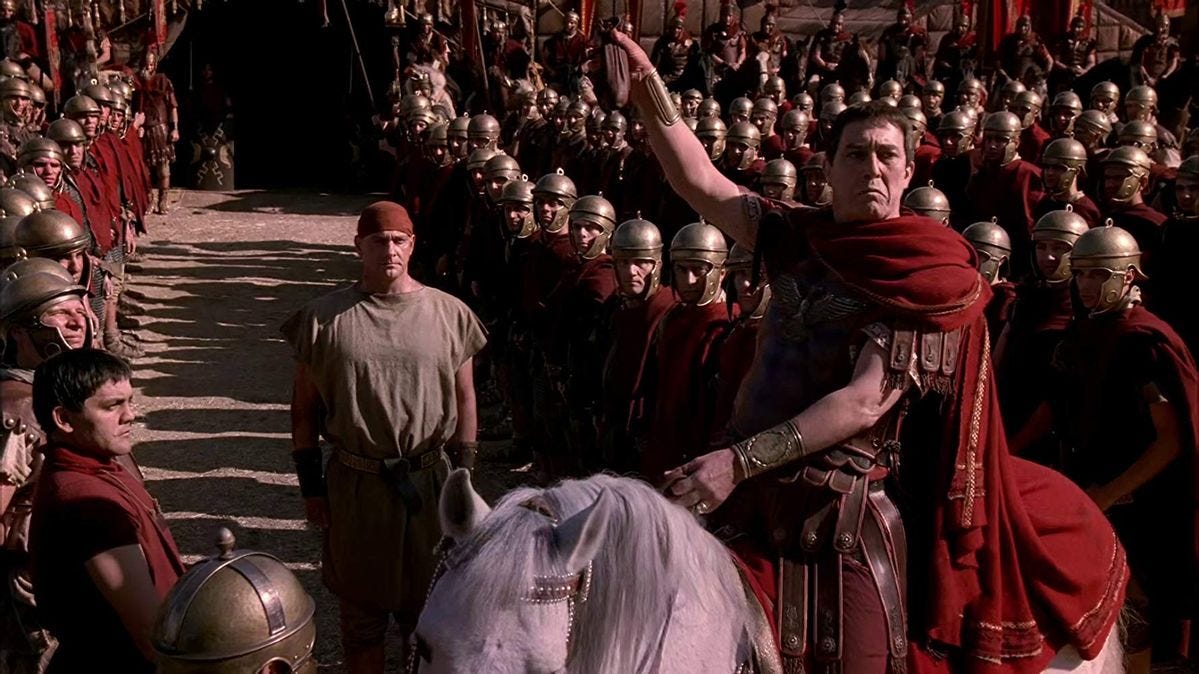
The ninth condition is psychological exhaustion. By Caesar’s time, the Republic’s crises had ceased to be just isolated events but accelerated into a continuous cycle of instability, civil war, and political fragmentation — a pattern many Romans regarded as an existential threat to the state itself.
Prolonged instability drains a society’s ability to oppose the centralisation of power. Romans, exhausted by civil wars and political fragmentation, could no longer summon the energy to defend a republican system that offered no relief. Under such psychological strain, order and stability become not only desirable but the final measure of civic self-preservation.
Caesar’s consolidation of power succeeded because it promised relief from this exhaustion. His rule offered an end to factional violence, senatorial paralysis, and the grinding uncertainty that had defined Roman life. To this end, Polybius observed that populations worn down by turmoil “prefer even servitude to chaos,” capturing the mood of a society ready to exchange procedural politics for stability.
Caesar rose because Rome recognised that its own self‑destructive civil wars had made extraordinary authority appear not merely tolerable but necessary for survival.
Symbolic and Moral Vacuum
The final, and arguably most important condition is the symbolic and moral vacuum. When a society’s foundational symbols lose their power to unify — its civic myths, religious rituals, ancestral norms, and shared narratives — the political order becomes hollow and no longer commands the respect that once sustained it.
Rome’s republican offices, once imbued with civic sacredness, no longer inspired public reverence. Moreover, the Senate, formerly the authoritative council of Rome’s patrician aristocracy, had devolved into a chamber drained of symbolic weight and incapable of eliciting loyalty, and the old rites that once bound Romans into a common identity had faded into gestures stripped of spiritual force and cultural significance.
As the symbolic weight of republican institutions evaporated, Romans increasingly invested authority in individuals rather than offices, seeking a figure who could embody the unity their public symbols and offices could no longer provide.
Caesar’s rise was anchored in this collapse of meaning. Rather than simply filling an institutional void, he offered a new locus of civic meaning — a single authority who could concentrate the civic ideals, restore religious functions, and public legitimacy that had once been dispersed across the Republic’s constitutional forms. His role as Pontifex Maximus encapsulated this transformation, allowing him to fuse political command with the religious guardianship that had traditionally anchored Rome’s identity.
Modern societies face similar risks when foundational symbols lose credibility, creating openings for figures who promise renewal through personal authority. Caesar succeeded because Rome’s symbolic vacuum made his legitimacy necessary.

The New Caesar
In The Decline of the West, Oswald Spengler wrote that “the Caesar‑type appears when the soul of a people has ceased to believe in its forms.” The ten conditions described above are not relics of Rome or France, but rather, are structural patterns that recur when civilizations enter late phases of development.
Systemic political breakdown, elite fragmentation and paralysis, socioeconomic polarisation, collapse of institutional legitimacy, cultural and moral disorientation, militarisation of public life, national mythos and the desire for unity, heroic cultural archetypes, collective psychological exhaustion, and symbolic and moral vacuum are not confined to antiquity or the nineteenth century.
They are visible today in varying degrees across Western societies, revealing structural patterns that recur whenever a civilization enters a late developmental phase.
Students of history cannot predict the future, but they can recognize patterns. The same forces that once produced Caesar and Napoleon are again gathering strength. Polybius called this the “course appointed by nature,” the cycle through which constitutions decay, disappear, and return to the point from which they began — a cycle that ends, inevitably, in the rise of a commanding figure.
The question is not if such a figure will appear, but when — and what type of Caesar he will be.
Join the fight for the Soul of our Civilization!
By subscribing to Atlas Press, you are supporting an honest group of guys who are working to help revitalize Western Civ through the re-enrichment of the Western mind. We appreciate your support greatly and hope you join us.
A man?
I can’t wait to support Caesar