


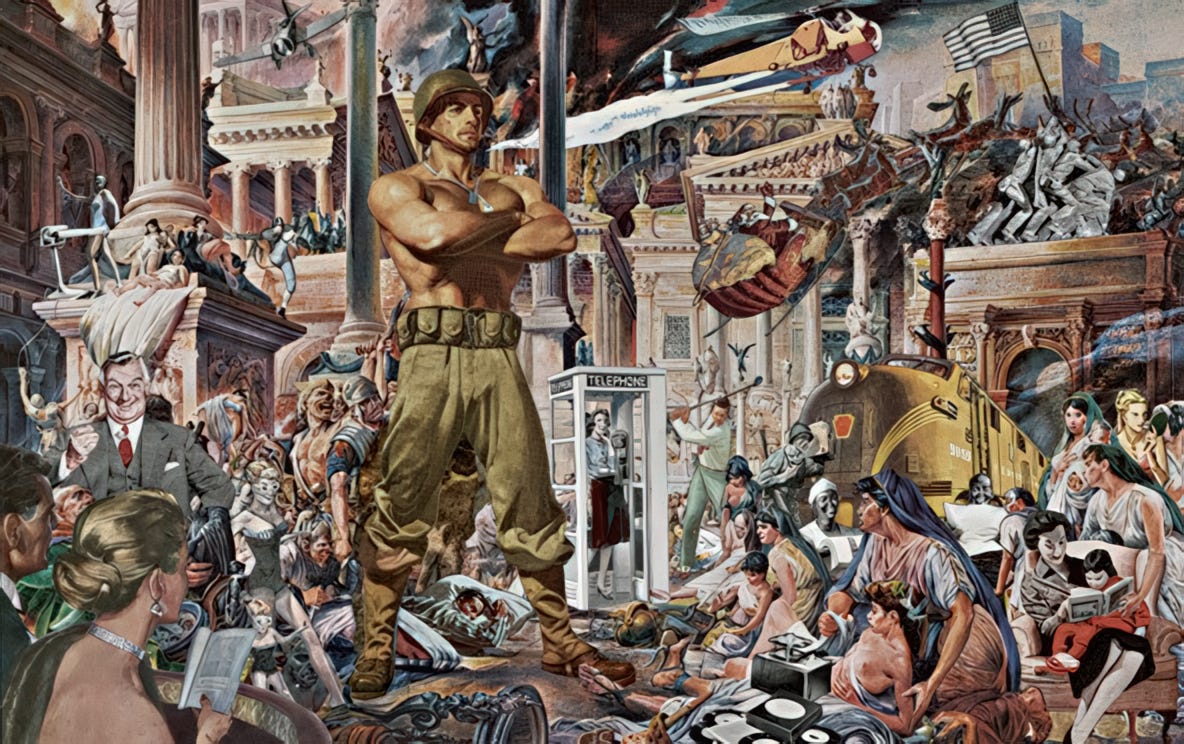
Even during the late Republic, the Roman Empire saw itself as the guarantor of world peace – the Pax Romana became the guiding ideology of a new order, as we can already read in the works of Cicero. Two millennia later, the Western world, led by the United States, is making a similar claim: The Pax Americana aims to secure global stability, spread freedom and facilitate economic exchange. Both orders are based on structurally comparable mechanisms: the military securing of global spheres of influence, the reinterpretation of hegemonic rule as a service to peace, and the systematic subjugation of all sources of disruption to the ideal of a universalised order. Above all, however, they also share a fundamental weakness: as long as ‘world peace’ is guaranteed by a political power characterised, by virtue of its republican system, by frequent changes in the ruling elites, this inevitably leads to a course that is inefficient in the long term, and indeed dangerous. For whilst one must never underestimate the forces of inertia exerted by the functional elite, éminences grises and geopolitical imperatives, internal political competition inevitably leads to rival clientelist systems that interlink the centre and the periphery, imperial and local elites, and which play out their rivalry in foreign policy as well – with consequences that are highly dangerous in the long term.
Reminder: You can get tons of members-only content dedicated to useful knowledge, and support our Mission at the same time for a few dollars per month 👇
Two full-length, new articles every single week
Get actionable principles from history to help you navigate modernity
Access to the entire archive of useful knowledge that built the West
Support independent, educational content that reaches millions
Pax Romana
After decades of Italy’s territorial expansion eastwards and westwards, followed by civil war-like conflicts between rival rulers – from Marius and Sulla, through Pompey and Caesar, to Mark Antony and Octavian – the fundamental principles of Roman order lay in tatters by the end of the 1st century BC. Admittedly, Cicero – a typical representative of those philhellenic Roman elites who sought in Greek philosophy the foundations for their own imperial ethic of rule – had already made it clear that, whilst submission to Rome meant the provinces had to relinquish their foreign policy autonomy, they would in return enjoy the benefits of participating in a peaceful Mediterranean world:
‘At the same time, Asia should bear in mind that it would not have been spared the calamities of foreign war or internal strife had it not been under Roman command. However, since this protectorate could not be maintained at all without the payment of taxes, the province may, with complete composure, exchange a portion of its revenues for everlasting peace and a tranquil life.” (Cic. ad Q. fr. 1.33f.)
At the same time, however, the late Republic in particular was characterised by extensive clientelist systems, which closely interlinked powerful senatorial dynasties, wealthy investors, provincial elites and neighbouring client princes, so that changes of power in Rome were usually associated with ever-changing foreign policy directions for the provinces as well (and vice versa); and although Roman rule was, on the whole, no longer really contested – since even on the periphery every ruler knew he was linked in one way or another to the Roman elite – this situation nevertheless led to great instability, from which not only the provincials suffered, but also the Roman middle classes, which was forced, time and again, to wage all manner of wars in the name of shifting, self-serving interests.
‘For we know, after all, that back then, when vast fortunes were lost by so many people in Asia, payments in Rome ground to a halt and credit collapsed; for when many people in a state lose their money and wealth, it is inevitable that they will drag others down with them into the same ruin: may our state be spared this danger! For believe me, as you yourselves can see: the credit and monetary system in Rome, which has its centre here in the Forum, is intertwined with and dependent on Asian capital; that capital cannot collapse without the local money market, shaken by the same upheaval, falling into ruin.” (Cic. Manil. 7.18f.)
Pax Americana
It is difficult not to think of the current global situation here. This is characterised not only by the final vestiges of the ‘Pax Americana’—which is currently transitioning from the stability of unipolarity to the equilibrium of multipolarity, and is naturally marked in both cases by a wide variety of frictions on the periphery—but also by the close intertwining of the respective financial interests of individual ruling elites with their local clienteles. This becomes particularly clear in the case of the USA, given not only the extent to which Joe Biden’s inner circle had significant financial interests in Ukraine and China, but also the fact that Donald Trump’s camp is involved in a wide variety of non-American economic projects: The transition between the various geographical and ideological focal points of US foreign policy is also, and perhaps above all, shaped by the desire to strengthen the domestic power base of its own clientelist system.
Due to their territorial fragmentation, their powerlessness in foreign policy and their largely negligible economic significance, European states are only to a limited extent genuine players in this game; yet here, too, it becomes clear just how deeply individual local elites are embedded in specific foreign-policy constellations (for example, with regard to African raw materials and, of course, Middle Eastern energy sources) and how they promote or hinder corresponding political developments, right up to the highest levels of government, as evidenced, for example, by the careers of the current French Head of State and the German Head of Government, both of whom maintained very close professional ties – not to say dependencies – with various major financial and investment groups.
Yet, of course, it is not the pursuit of the economic exploitation of the ‘provinces’ that lies at the heart of the Western world’s official ideology, but rather the self-portrayal of the USA as the guarantor of a global order, whose various instruments – such as the UN, NATO or the World Bank – are intended to ensure, in a wide variety of ways, control over trade routes, the stabilisation of US-aligned liberal -democratic systems of governance, and, of course, the integration of the outside world into the US military, financial and energy systems; yet at the same time, this is understood as ‘rule-based world peace’. For, as in the case of Rome, it must be emphasised that an idealistic, a pragmatic and a cynical interpretation of the respective ‘world peace’ are by no means mutually exclusive; and indeed, for some of those affected, the economic advantages of integration into the respective hegemonic peace system do in fact outweigh the disadvantages of losing de facto freedom in foreign policy and, all too often, in domestic policy as well.
Just as in the Roman world, the increasingly brutal shifts in policy between the various US clientelist systems – and thus in foreign policy orientations – most flagrantly illustrated by the wars in Ukraine and Iran – also pose a steadily growing danger, not only to the respective allies or subjects, but also to their own citizens, who must expect ever greater deregulation in the energy sector and in everyday consumption.
World peace
This, however, once again raises the question of whether this trend will continue and to what extent it can be predicted by studying the late Roman Republic. The facts are well known: Pompey’s conquest of the eastern Mediterranean, just like the conquest of Gaul, had set a dangerous precedent, where not only the overextension of Rome’s own forces but also the excessive concentration of power in the hands of a single individual heralded the end of the Republic. At the same time, the increasingly unscrupulous treatment, since the 2nd century, of Rome’s allies and client kings – who were regarded less and less as valued friends and more and more as a disposable resource to be exploited, whose demotion to the status of subjects and provinces seemed only a matter of time – revealed just how far Rome had strayed from its original ideals. Just how dangerous such contempt, combined with territorial overextension, could become was demonstrated not only by the Greek revolt during the war against Mithridates, but also following Crassus’s defeat by the Parthians, when a large part of the East threatened to break away and Rome’s prestige had also suffered a dangerous blow. No wonder that, alongside the very real desire to be part of Rome’s project of peace and prosperity, resistance to the very idea of ‘peace’ – which, from the standpoint of absolute freedom, seemed little more than slavery – was repeatedly voiced, particularly on the periphery, as Tacitus put it into the mouths of the Britons even during the Imperial period:
‘Robbers of the world, having exhausted the lands with their ravages, they [i.e. the Romans] now plunder the sea as well – greedy when the enemy is rich, thirsty for glory when he is poor; neither the East nor the West has sated them; they alone, of all peoples, crave abundance and desolation with equal passion. They falsely call their theft, murder and plunder ‘Imperium’, and wherever they create desolation, they call it ‘peace’.” (Tac. Agr. 30.)
The endless internal and external conflicts in Rome were followed by the autocratic rule of Augustus, who exploited the general desire for order and peace on the part of both citizens and subjects to present his Principate not only as a moral rebirth of the Republic, but also as a restoration of the ‘aurea aetas’, the ‘golden age’, when gods and heroes still dwelt upon the earth and peace, harmony and abundance were the order of the day, as is particularly evident from the design of the ‘Ara pacis’, the ‘Altar of Peace’, with which Augustus had himself celebrated for having achieved ‘world peace’. The Pax Romana he created was, of course, by no means characterised by the absence of violence, but rather by its monopolisation: internally, through the Emperor’s unilateral assumption of control over the entire foreign policy and thus also over clientelistic ties, against which the last remnants of the Senate’s privileged contacts carried little weight; externally, through control over all the armies and the groundbreaking strategic decision—with a few exceptions, which were, as usual, declared to be ‘bella iusta’—to refrain from further expansion and to preserve the status quo rather than overstretch the empire’s borders.
Even the great enemy in the East, the Parthian Empire, was largely left in peace following a diplomatic arrangement which both sides could declare a ‘victory’ whilst saving face, with the result that the Roman eastern frontier—which ran across Armenia, Western Mesopotamia and the Syrian Desert—was never again truly shifted in the long term until the Arab expansion. From then on, right up until the Migration Period, minor police operations against ‘barbarian’ peoples were entirely sufficient to secure the emperor the traditional charisma of a victor and the loyalty of the troops; where this was disregarded – for instance, during the conquest of Britain or Trajan’s campaigns – the Roman state had to make heavy sacrifices in the form of tax burdens or the number of casualties. And so there indeed came that brief but still-remembered golden age of the Pax Romana, when it truly seemed to a not inconsiderable part of the world that, at least in the Mediterranean world, world peace had become a permanent reality, as Aelius Aristeides enthused:
‘Instead of vying for dominion and supremacy—which was the cause of all the wars of earlier times—some lead a most pleasant and peaceful life, akin to water flowing silently by, happy to be free from toil and suffering, and filled with regret that they once fought in vain for mere shadows. The others do not even know what dominion they once held, nor do they remember it. […] People no longer believe in wars, or even that they ever took place; mere tales of them are regarded by most as myths. But whenever fighting flared up somewhere along the borders—as is natural in an immeasurably vast empire, given the ferocity of the Dacians, the plight of the Libyans or the misery of the peoples of the Red Sea, who are incapable of enjoying the blessings of the present—then the wars quickly vanished again, just like myths, and so did the tales of them.” (Ael. Arist. Rom. (or. 14) [216] 69–71)
One may well expect that the future of the Western world, too, will exhibit some of these characteristics. Even now, the looming overstretch of US—and thus, by extension, Western—influence across the globe is becoming apparent: The withdrawal from Kabul was the first sign, visible to the outside world, that the financial and technical superiority of the USA, combined with its geostrategic position and economic clout, no longer offered a lasting guarantee of global hegemony, particularly in view of the declining popularity and credibility of the Western model of civilisation. The war in Ukraine and the intervention against Iran reinforce this impression, all the more so as this is the first time that organised resistance from Russia and China has become apparent.
At the same time, however, the long-felt disregard for America’s allies – foremost among them NATO – is also coming to light. The asymmetry between the two sides of the Atlantic had always been evident, and since the alliance’s foundation, no one had harboured any illusions that a genuine partnership of equals was even desired; rather, at best, the Europeans were expected to provide funding and secondary support forces. The presidency of Donald Trump – who, in the manner of Roman demagogues, even threatens to take away his own allies’ territory and goes so far as to portray such an annexation as an act of assistance – has torn the mask off diplomatic pretence and laid bare for all to see the sad reality of a divided, incompetent Europe that is merely despised by the US.
The Future
What lies ahead? Is there still any hope that Europe might develop into an independent Hesperialist pole within the Western world, is its provincialisation within a US-led empire a foregone conclusion, or might we even witness a ‘hot’ phase of a belated and undoubtedly futile attempt to evade US supremacy, just as the late-Republican Greeks did before their final subjugation? And what will become of the future of this ‘Pax Americana’: is it to be expected that Donald Trump will retreat to the core of the US empire, as was already hinted at in the ‘American Hemisphere’ doctrine, and accordingly extend his influence across the two Americas, as the threats against Venezuela, Canada, Mexico and Cuba so vividly illustrate; whilst otherwise (with the exception of the European states, Australia and New Zealand) respecting the spheres of influence of other civilisational powers such as Russia, India and China, and accordingly having no intention of interfering in irredentist ambitions regarding Taiwan or the Baltic states? It will undoubtedly take several more years before this fundamental question is resolved – a question to which even the erratic US President is unlikely to be able to provide a genuine answer – and so it cannot be ruled out that the US, too, may experience its own ‘Carrhae’ against China or perhaps even Russia, in order to test the limits of what is possible and definitively transition from the dynamic and ‘republican’ phase of its history to one of imperial stability and widespread stagnation. Be that as it may: the window of opportunity for European states to secure a final remnant of autonomy within this constellation is now alarmingly short.
Admittedly, alongside the purely power-political aspects, we must not overlook the civilisational ones. Even now, a general weariness has taken hold, and not only in Europe; a reluctance to look beyond the petty, day-to-day concerns of individual existence and to risk losses or sacrifices in the here and now for the sake of the common good – be it of a pragmatic or idealistic nature – not to mention that fundamental willingness, in an emergency, to risk one’s life for a cause that matters more than one’s own existence. Even the Romans of the Empire – not to mention the inhabitants of the provinces – were only too happy to retreat behind the extensive walls and fences of their global empire, leaving the defence of their civilisation against the ‘barbarians’ – whom they both despised and feared – to professional soldiers, and, when in doubt, submitting to whoever was the more powerful at the time: Where, only a few generations earlier, entire generations had sacrificed themselves for a civilisational ideal and political convictions, there now reigned only a jaded and cynical cosmopolitan class, for whom peace, prosperity and order were a right, yet very few were willing to be held to account for how these came about. It was thanks to the incredible institutional, military and logistical stability of the Roman Empire that this illusion could be sustained for several centuries; yet its downfall was a foregone conclusion from the very beginning; and so there can be little doubt that ‘post-historical’ Europe, too, if it remains incapable of ensuring its own security, will go the same way.
Join the fight for the Soul of our Civilization!
By subscribing to Atlas Press, you are supporting an honest group of guys who are working to help revitalize Western Civ through the re-enrichment of the Western mind. We appreciate your support greatly and hope you join us.

Western Europe will fall to the Muslims, aided by the Left (whom the Muslims will then eliminate, as in the Iranian revolution). After the brutal brother wars of the last century the European gene pool has destroyed its courageous bloodlines. The result is the current apathy as barbaric Africans and South Asians flood into historic European nations, to feed off the social welfare carcass and breed until the native populations are diluted or erased. The barbarians have been welcomed within the gates and they cannot believe their good fortune. This process has already begun in the western hemisphere, primarily in Canada and the US.
Trump most resembles Emperor Heraclius, who with great energy restored some of the Eastern Empire’s lands and security, only to lose all of that and more in the onslaught of Arabic Islam a few years later.
Persia and Rome at that time were like two heavyweight boxers, punch-drunk and exhausted from their continual conflicts. The Arabs found easy pickings in their violent expansion. The same is true today.