
Odyssey to Oblivion
How Small Surrenders Lead to Devastating Defeats


We like to tell ourselves that the small decisions we make are inconsequential, and that a single compromise costs nothing and changes nothing. But they aren’t inconsequential. Each concession, however small it may seem, begins to reorient the will and weakens us until we become something we no longer recognize.
Building on the Nicomachean Ethics of Aristotle, St Thomas Aquinas wrote in his Summa Theologiae that repeated acts generate dispositions in the soul. No man, he argues, becomes courageous by a single act of bravery, and no man becomes a coward by a single retreat. The habit of surrendering to the lesser renders one unwilling — or rather, incapable — of resisting the greater, and in time, this process fundamentally alters the very character of the man.
For this reason, a man becomes what he repeatedly chooses and this truth, which holds for individuals, holds with even greater force for the collective.
Civilizations rarely collapse as a result of one dramatic defeat, but gradually, through innumerable concessions made along the way. What a civilization once condemned it eventually tolerates; what it tolerates it soon normalizes; and what it normalizes it finally defends as a right until it becomes unrecognisable to the civilization that once condemned it.
These surrenders are not confined to the battlefield only.
As a civilization, we surrender when we allow the traditions and rituals of our religion to be abandoned. We surrender when we allow our ancestors and our heroes to be defamed. And finally, we surrender when we allow our language, our history, and our culture to be replaced.
You must understand that the smallest surrenders, once accumulated, fundamentally alter us until a devastating defeat becomes inevitable because we no longer have the will to defend what we once believed and resist what we once condemned.
This is why we must resist.
Reminder: You can get tons of members-only content dedicated to useful knowledge, and support our Mission at the same time for a few dollars per month 👇
Two full-length, new articles every single week
Get actionable principles from history to help you navigate modernity
Access to the entire archive of useful knowledge that built the West
Support independent, educational content that reaches millions
The Historical Precedent
Over the course of centuries, Rome made a series of seemingly minor concessions that gradually undermined the discipline that made it invincible. Their precarious relationship with the Germanic tribes along the Rhine and Danube is the clearest illustration of this phenomenon.
At first, Rome permitted small groups of barbarian foederati to settle just beyond its frontiers, believing they could be managed as buffer states against more hostile tribes deeper in the Germanic interior and those from the Eurasian Steppe. This represented a stark but pragmatic concession from Rome’s traditional policy of maintaining hard, militarized borders. But once the empire grew accustomed to outsourcing the stability and safety of their frontier, it became easier to allow these very same barbarians to cross the pomerium — Rome’s sacred boundary — and settle within Roman territory, provided they acknowledged imperial authority.
Once this concession was normalized, the next more transgressive concession was more palpable and more consequential. Rome began recruiting these same Germanic tribes as auxiliaries in her legions, then later as regular soldiers to compensate for its declining native manpower. So, what began as a temporary measure became habitual. The legions — once the embodiment of Roman discipline and power — were increasingly filled with men whose loyalty was to their tribal leaders rather than to the Eternal City itself.
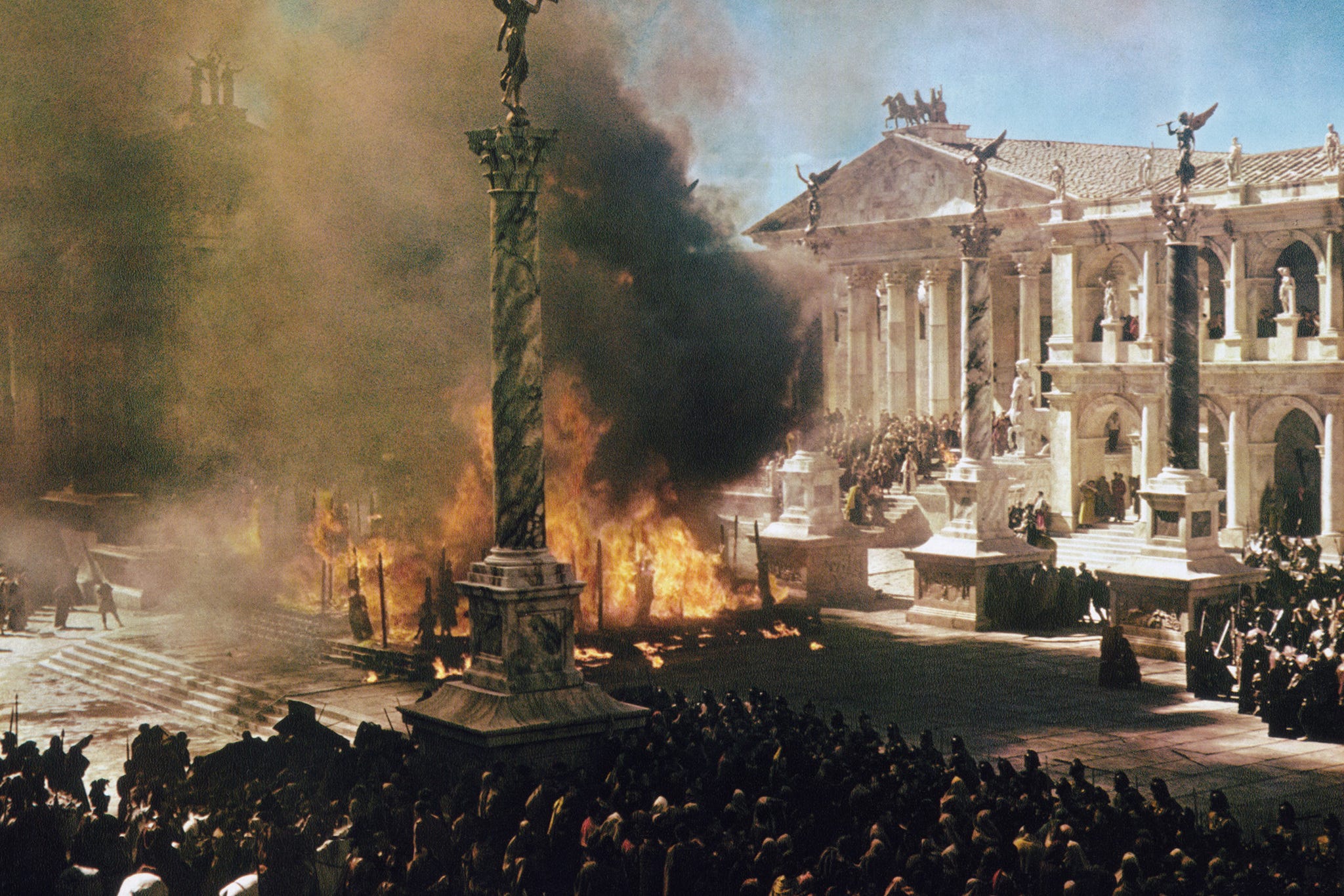
By the fifth century, Rome had become almost entirely dependent on these federated armies that when crises struck, they lacked both the will and the capacity to reassert control over the people it governed. In 410 AD, Alaric’s Visigoth army — themselves former foederati — marched on Rome and then sacked the city in a cataclysmic event from which Western empire never truly recovered.
We might ask, why couldn’t the Romans defend their city?
The truth is that the Romans were defeated the moment they surrendered their legions — the result of countless individual concessions made along the way.
The countless fathers who spared their sons from the disciplines of the legion, and instead, gave them a life of luxury.
The countless mothers who allowed their households to abandon traditional Roman virtue to the novelty of foreign fashions and customs.
The countless sons who preferred the entertainments of the amphitheater to their civic obligations.
The countless daughters who neglected the solemn religious rites that bound household and empire.
But this is not a truth confined to the pages of history, but rather, a reality we face today. Granted, we do not face the imminent violence of Germanic tribes at our gates. Our enemy is more subtle, more patient, and far more insidious — yet its aim is the same: to weaken our resolve, to erode our foundations, and ultimately to destroy our cities.
The Modern Barbarian
You must understand that unless you have an incredibly disciplined will and a strong philosophical and moral foundation, close proximity to subversive people or even entertaining subversive ideas will fundamentally alter who you are and how you perceive the world.
The harsh reality is that you are not the exception, but the rule.
Just as Rome was fundamentally altered by the ideas and habits it permitted within its sacred boundaries, we too are reformed by the ideas we allow into our cultural bloodstream.
Marxism is a radical ideology that is diametrically opposed to the Christian religion and Western Civilization itself. It is built on the philosophical premise that the human being — and by extension, human history — is defined primarily by class warfare, the abolition of private property is necessary for true liberation, that truth and morality are influenced by and subordinate to material conditions, and that this progress can only be achieved through the systematic dismantling of traditional Western cultural and religious institutions that bind us to our past.
Long ago, Marxists realized that Western Civilization could not be overthrown by frontal military or political assault. Its Greco-Roman foundations, Christianity faith, and ideas of individuality and liberty were too deep and too resilient to be overcome by force. So they shifted from revolution to infiltration, directing their efforts to social, cultural, political, and artistic subversion which they referred to as a process of demoralization and destabilization with the ultimate aim of destruction.
This victory, they believed, would be brought about by incremental elite-capture of institutions, education, and the media and entertainment industry.
Marxist understood the power of myth and symbols, the stories a people tells itself, the art it produces, and the heroes it venerates. If these could be gradually reinterpreted and subverted, then Western Civilization would lose its soul and the will to defend itself.
But it’s not that simple and straightforward. First, you are conditioned to tolerate your heroes being critiqued in academia, and then attacked openly in the arts and the public discourse. Eventually, it becomes a right to tear down the statues of our heroes and rewrite the pages of our history as an act of reparation against the so-called sins of the past.
Unlike the barbarians of old, Marxists understood that you don’t need to besiege a city to destroy it. If you can undermine the confidence of the men and women defending its walls, if you can make them hate their history, their culture, their ancestors, and their religion, they will open the gates and allow you to destroy the city themselves.

The Odyssey Controversy
In recent months, Christopher Nolan’s modern adaptation of Homer’s Odyssey has polarized audiences, drawing critical acclaim and condemnation.
Those in favor of his adaptation commend the auteur’s bold artistic choices, and his ability to transform a static text into something truly immersive for contemporary audiences. On the other hand, those who oppose the film consider it less as an entertaining appropriation but more of a subversive attack on Western history and identity itself.
In response, many have asked, “why do people care so much about The Odyssey? It’s just a film”.
Yes, it is just a film directed by one of the most accomplished directors of our age, supported by a star-studded cast. It will likely be visually striking, musically powerful, commercially successful, and showered with accolades. But what these observers fail to recognize is that the controversy is not about the film itself, but about what the film represents.
The Iliad and the Odyssey are the foundational myths of Western Civilisation, and form the basis of our literary canon. To surrender these so readily is to surrender our very identity and drift towards cultural oblivion.
Granted, criticisms of the film are trivial and indulge in the same identity politics they claim to despise. Whether the entire cast is comprised of native Greek-speakers who can trace their lineage back to ancient Attica and the Peloponnese is beside the point.
However, the more astute critic recognizes that the West has been forced to concede so much of its history already, to condemn its heroes, and to renounce its religion all in the name of tolerance. These concessions are no longer isolated, but cumulative, and all designed to bring about cultural defeat. For this reason, the film has evolved into a cultural line in the sand for those who recognize that the West has been subjected to decades of ideological subversion and have made the conscious decision to tolerate it no longer.
Our myths are not just stories, they’re formative ideas that fundamentally shape who we are and what we believe. From these we learn what is good and what is evil, what is virtuous and what is vicious, what to pursue and what to avoid. The variety of human experience is captured in these texts, and to surrender them piece by piece to ideological subversion is unacceptable.
The Roman lesson and the theological tradition converge on the same counsel: guard the small frontiers and don’t make concessions to your enemies because that is where the decisive battles are either won or lost long before the final assault arrives.
The intention of the hyperbolic statement that those who support this film are “enemies of the west” is this: you may not be assaulting the civilization yourself, but you are — either consciously or unconsciously — opening the gates for those who will sack the city one small cultural accommodation at a time.
What Must I Do?
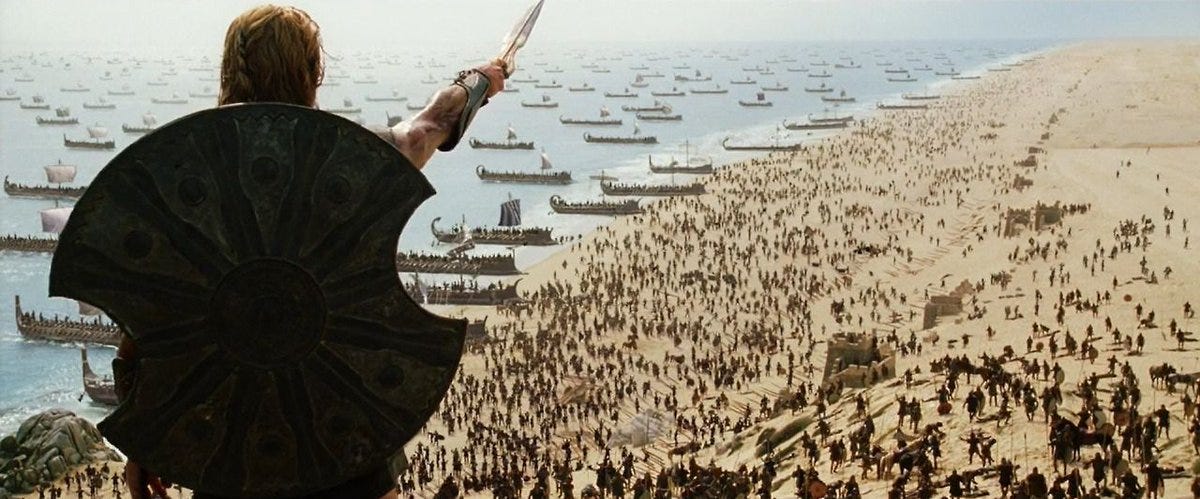
The Odyssey begins with the infamous destruction of Troy. The Greeks, who had besieged the magnificent city on the Anatolian coast for a decade, could not breach its walls because Troy was built as an impenetrable fortress.
Even with the great heroes such as Achilles, the Greeks could win skirmishes but never overcome the Trojans. Cunning Odysseus convinced the Greeks to feign retreat and offer their enemies a gift.
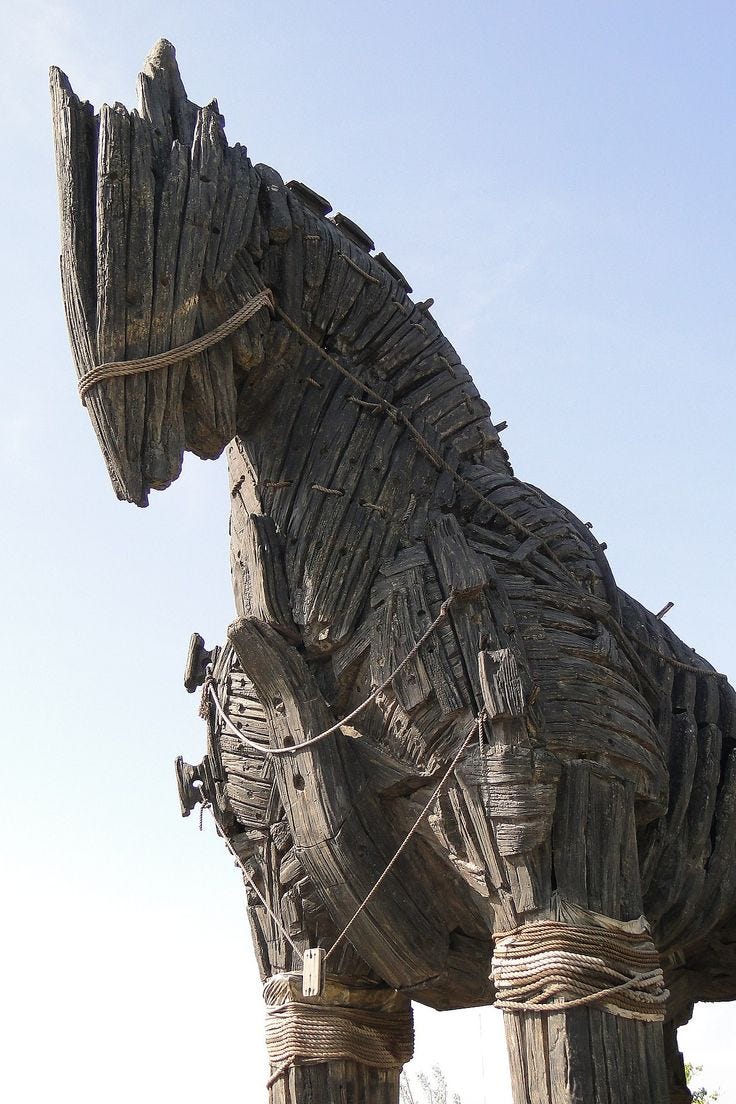
We know how the story ends. The gift was a large wooden horse carefully constructed as the very symbol of their city and dedicated to their gods. The Trojans conceded by allowing something foreign into their city, and that night, the dozens of Greek soldiers emerged from inside the subversive offering, slew the Trojan guards and opened the gates allowing the Greek host to come pouring in and overwhelm the city. Within hours, Troy was in flames, its inhabitants massacred, and its glory consigned to the pages of history.
Every concession — whether disguised as a gift or presented as a harmless idea — is a Trojan Horse. To accept it is to invite the enemy into your walls. Every time you allow your family, your friendships, your church, your school, your business, your community to tolerate what is dangerous and foreign, you begin the same process that doomed Troy. And this is precisely how Marxist subversion advances — not necessarily through open assault, but through small ideological reorientations and accommodations that appear benign until it’s too late.
The Trojan Horse, rightly understood, is a symbol of tolerance, and if tolerance means the end of Western Civilization, then we must put an end to tolerance.
You cannot concede. You cannot surrender. Certain lines in the sand, certain sacred boundaries can never be crossed — ever.
Troy is gone.
The Trojans are gone.
People can be replaced, and cities can be remade, but once your civilization is gone, it’s gone forever.
Join the fight for the Soul of our Civilization!
By subscribing to Atlas Press, you are supporting an honest group of guys who are working to help revitalize Western Civ through the re-enrichment of the Western mind. We appreciate your support greatly and hope you join us.
Hermes Trismegistus / Thoth.
I’m not going to Oblivion with Freemason Paedos