
Lessons from the Battle of Cannae
From annihilation to empire...

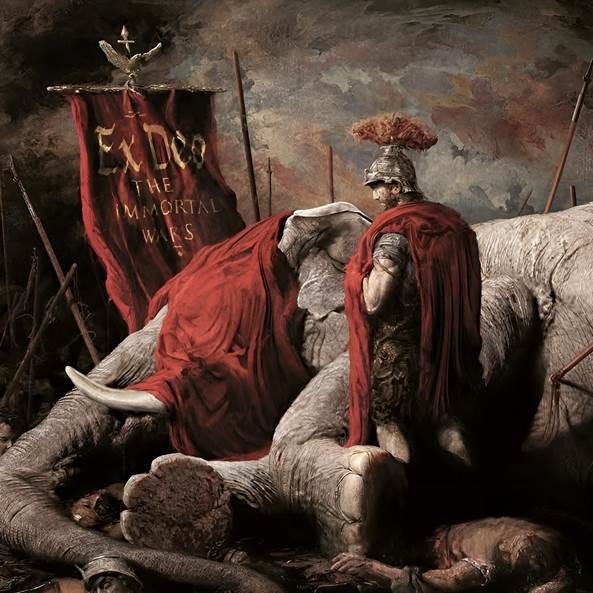
The Battle of Cannae stands as one of antiquity’s most devastating defeats, yet also as a crucible in which Roman resilience was tested, ultimately forging a thriving republic into the greatest empire in history.
Context of the Conflict
The Second Punic War (218-201 BC) was born of rivalry between Rome and Carthage, two ancient powers whose ambitions for hegemony clashed along the shores and fields of the Mediterranean.
Rather than advancing via the expected routes, the Carthaginian general Hannibal Barca made the bold decision to invade Italy from the north, leading an army of 40,000 infantry, 10,000 cavalry, and 37 war elephants – accompanied by a variety of Iberian and Celtic auxiliaries they enlisted along the way. Though this force lacked a common language and culture, it was bound together by a united resolve to strike down the Roman Republic, whose rising power threatened them all.
Reminder: To get our members-only content every week and support our mission, upgrade to a paid subscription for a few dollars per month. You’ll get:
Full-length, new articles every single week
Access to the entire archive of useful knowledge that built the West
Get actionable principles from history to help navigate modernity
Support independent, educational content that reaches millions
The Romans had been expecting an invasion by sea or through Spain, and as a result, had moved their forces leaving their northern frontier undefended. Therefore, Hannibal’s audacity to lead such a vast army – complete with war elephants – across treacherous mountain passes caught Romans completely unprepared.
The Romans, desperate to prevent Hannibal from advancing any further, moved their legions quickly across the peninsula in the heat of Italian summer. This left the legions fatigued and less coordinated, while Hannibal’s forces, who had chosen the battlefield and prepared carefully, were comparatively rested and prepared for battle. Thus, Hannibal’s daring march and the disorder and exhaustion made the Romans all the more vulnerable to what was to come – known to us in history as the infamous Battle of Cannae.
How did the Romans recover from the complete annihilation of their army only to burn the capital city of their ancestral enemy to the ground only 70 years later – and what can we learn from their example?
The Brutality of the Battle
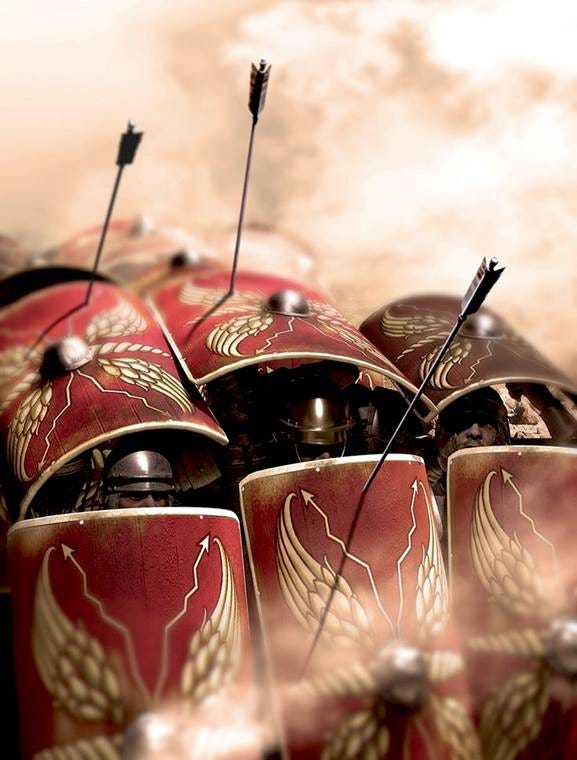
Polybius, ever the analyst of military science, observed in his Histories that Hannibal’s genius lay in exploiting Roman rigidity, as the legion was known to “rely on their numbers and mass their heavy infantry, pressed forward upon the enemy’s center, which gave way before them”. Anticipating this Hannibal stretched the Carthaginian army wide as the battle began and commanded his army to slowly but surely wrap around the Roman center as they advanced – a strategy known as the double-envelopment.
Thus was set the stage for annihilation, allowing the Romans to advance until they suddenly “attacked the flanks, while the cavalry, having routed their opponents, fell upon the rear”. The Romans, realizing they had been completely surrounded on all sides, “were cut down where they stood” with possibility of escape or surrender.
The Romans were exhorted by their centurions not to break ranks but maintain battle formation as wave after wave of Carthaginian onslaught broke upon them until slowly but surely they were worn down by attrition. As Hannibal rightly predicted, the Romans’ willingness to remain locked in their rigid blocks with shields pressed together and men standing shoulder to shoulder. Their discipline became their doom, as the density of the formation left them immobile, unable to maneuver or escape the suffocating Carthaginian ring pressing in on them – soldiers without room to even wield their swords and shields in self defense. Soldiers died where they stood in the tens of thousands for an entire afternoon, suffocating in the crush, but refusing to flee as they “preferred an honorable death to life with ignominy”.
In his History of Rome, Livy cites the sheer magnitude of the manual labor required to slay tens of thousands of Romans who refused to surrender. In the midst of the fighting, he notes that the Hannibal had to call upon the Iberian and Celtic reinforcements to help in the massacre of their foes as the Carthaginians “were almost exhausted, though more with slaying than with fighting”. The slaughter at Cannae as an unparalleled catastrophe that presented an existential crisis to the Roman Republic, as “So many thousands of Romans were slain, that the plain was covered with blood, and the heaps of dead lay piled upon one another”.
By day’s end, between 50,000 to 70,000 Romans lay dead on the field of Cannae, including their consul Lucius Aemilius Paullus. The psychological devastation was immense as Rome, which had become so accustomed to victory, had never “been brought so near to ruin”.
Echoes throughout the Empire
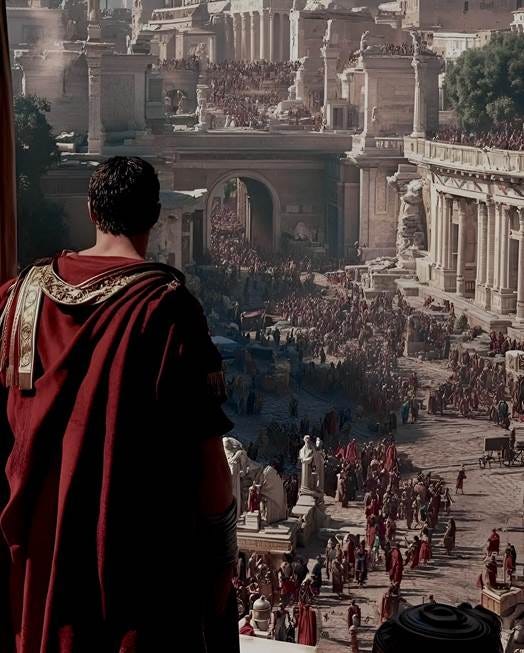
The defeat at Cannae reverberated across the Roman Republic and beyond. Allies wavered foreseeing the potential of a new political order while neighboring kingdoms such as Macedon entered into alliance with Carthage effectively encircling Rome with enemies on multiple fronts.
However, from this defeat emerged the indomitable spirit of the Roman Republic, a spirit that came to define one of history’s greatest civilizations. Where lesser states would have bent the knee and sued for peace, Rome stood resolute as “no one spoke of peace… or surrender”, convinced of its destiny for greatness. This conviction infused its people with an unyielding will and projected an aura of invincibility that awed allies and terrified enemies alike. In doing so, Rome reinforced the Western Way of War – an enduring tradition that, since antiquity, has shaped the very character of Western civilization to the modern age (link).
The Senate turned to Quintus Fabius Maximus, whose cautious strategy earned him the epithet Cunctator – the Delayer – followed and harassed Hannibal’s army that marched throughout the Italian Peninsula. They mourned the dead for thirty days, refused to ransom captives, and raised four legions under Scipio Africanus to invade Africa directly in order to bring Cato’s prophecy to fruition, “Cathago delenda est” – Carthage must be destroyed.
The Destruction of Carthage
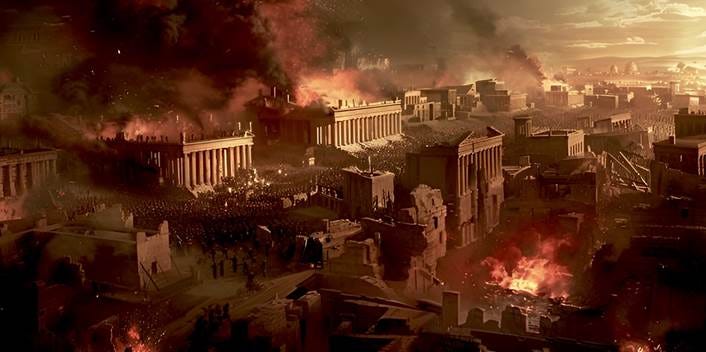
Under the leadership of his descendant Scipio Aemelianus, Appian captures the finality of the siege stating Carthage, “a city which had flourished seven hundred years from its foundation, which had ruled over many lands, islands, and seas, and which had vied with Rome herself for empire” was utterly destroyed.
And herein lies the tragedy.
Appian recounts that as the Roman legions razed the Carthaginian capital to the ground, Scipio is said to have “shed tears and publicly lamented the fortune of the enemy”. In the fires of Carthage, he saw the rise and fall of every kingdom and empire – of the Trojans, of the Medes and Persians, of the Macedonians, knowing that one day, his beloved city of Rome would suffer the same fate and be reduced to ashes.
For Scipio, the burning of Carthage was not merely a Roman triumph but a meditation on the transience of power and the fragility of human life. He understood the paradox, that the very impetus that propelled Rome to greatness was also its greatest vulnerability. History is cyclical, hubris invites decline, and that even conquerors must reckon with the reality that envy and decadence, like fire, always rise to the highest points and can throw down even the mightiest of empires that people, only moments ago would believe are invincible.
However, the Romans believed themselves to be somewhat inoculated from this process. They believed that forced austerity and discipline hardened them for adversity, effectively shaping a people fit for conquest. From their earliest days, the Romans were taught that luxury enfeebled the spirit, while simplicity in food, dress, and manner bred personal fortitude and a subsequent civilizational indomitability. Thus, through the rigors of discipline and the denial of excess, Rome forged a character that could withstand the calamity of Cannae and rise even stronger to become masters of the world.
Lessons from History
Hannibal’s triumph at Cannae, though spectacular, was futile as he failed to translate a tactical annihilation into a lasting strategic victory. In the aftermath of the slaughter, Hannibal hesitated to march upon the Eternal City, effectively granting his enemy the time to rally, raise new legions, and retaliate in kind. Thus, the very moment that might have broken the Roman Republic and forever altered the trajectory of Western history became a cautionary tale to all ‘Great Men of History’ who followed.
For the Romans, their defeat at Cannae became one of their greatest victories as it revealed a virtue that transcends time – the refusal to surrender. Their capacity to absorb catastrophe without breaking not only reflected the power of their institutions, but reinforced their belief in Roman exceptionalism. From the blood-stained fields of Cannae to the trenches of the Somme, this indomitable spirit has come to define Western Civilization – the conviction that defeat, however devastating, is never final so long as the indomitable spirit remains.
Unimpaired prosperity cannot withstand a single blow; but he who has struggled constantly with his ills becomes hardened through suffering; and yields to no misfortune. No, even if he falls, he still fights upon his knees. – Lucius Annaeus Seneca (Epistulae Morales ad Lucilium: De Providentia)
Always a pleasure to collaborate 🫡