


It may surprise many today to learn that Leonardo da Vinci died convinced that he was a failure.
As Giorgio Vasari recorded, in his last words the Renaissance Man par excellence lamented to King Francis I of France that he had “offended God and mankind in not having worked at his art as he should have done”.
After all, Leonardo’s insatiable curiosity and need to push the boundaries of knowledge often resulted in him starting many things and finishing few, to the frustration of himself and his clients. As a result, beyond the now world famous paintings he produced to earn a living, a vast number of his works have fallen into obscurity, despite their genius.
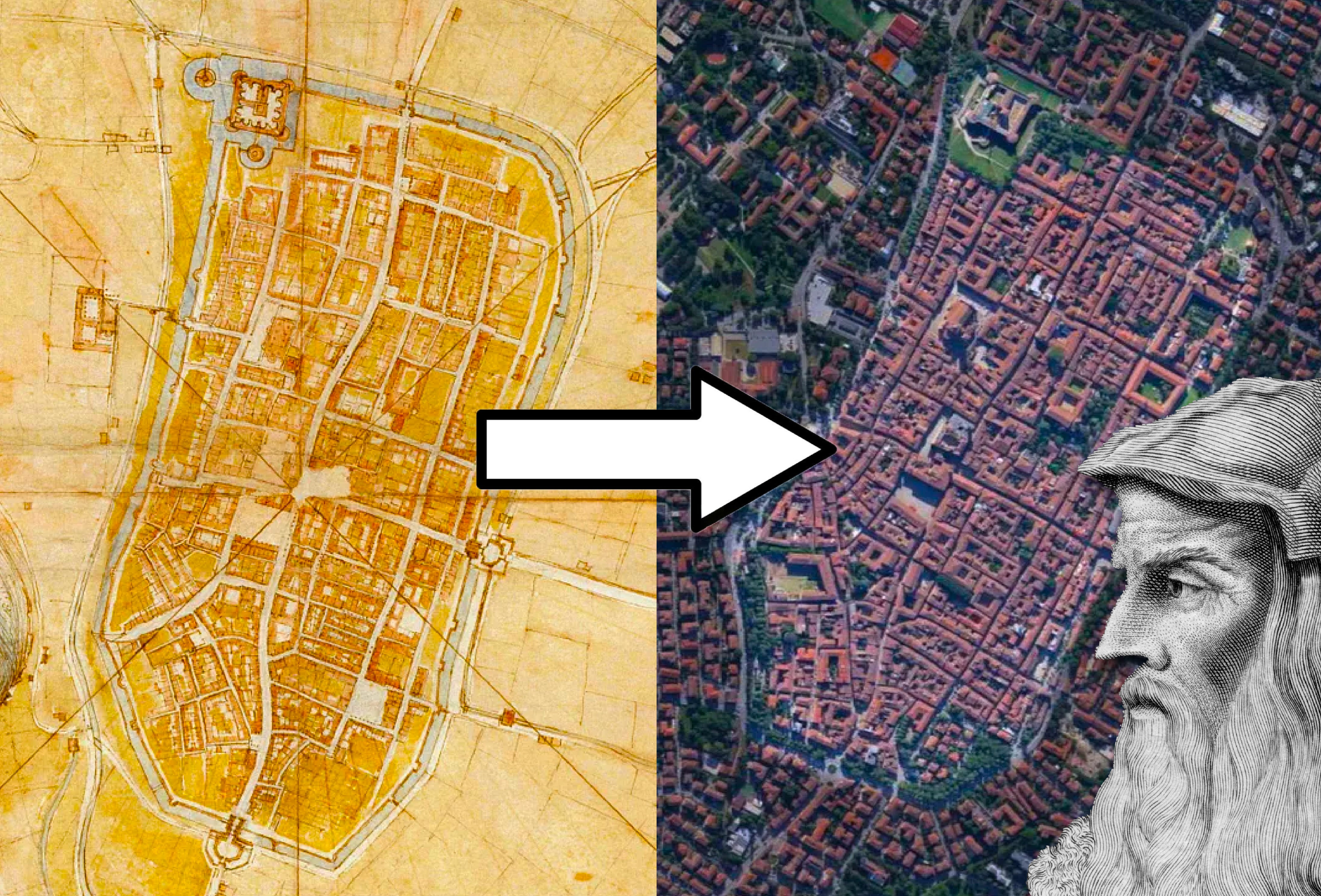
One such masterpiece that the world has long since forgotten is an extraordinary map that he produced of the city of Imola in the autumn of 1502.
At first glance, it may appear unremarkable. But then the realization dawns. How was Leonardo able to produce a map worthy of satellite imagery centuries before the age of powered flight?
The answer was rather simple, but that did not stop it from completely changing the way we considered maps in the Western world…
Reminder: You can get tons of members-only content dedicated to useful knowledge, and support our Mission at the same time for a few dollars per month 👇
Two full-length, new articles every single week
Get actionable principles from history to help you navigate modernity
Access to the entire archive of useful knowledge that built the West
Support independent, educational content that reaches millions
Art or Science?
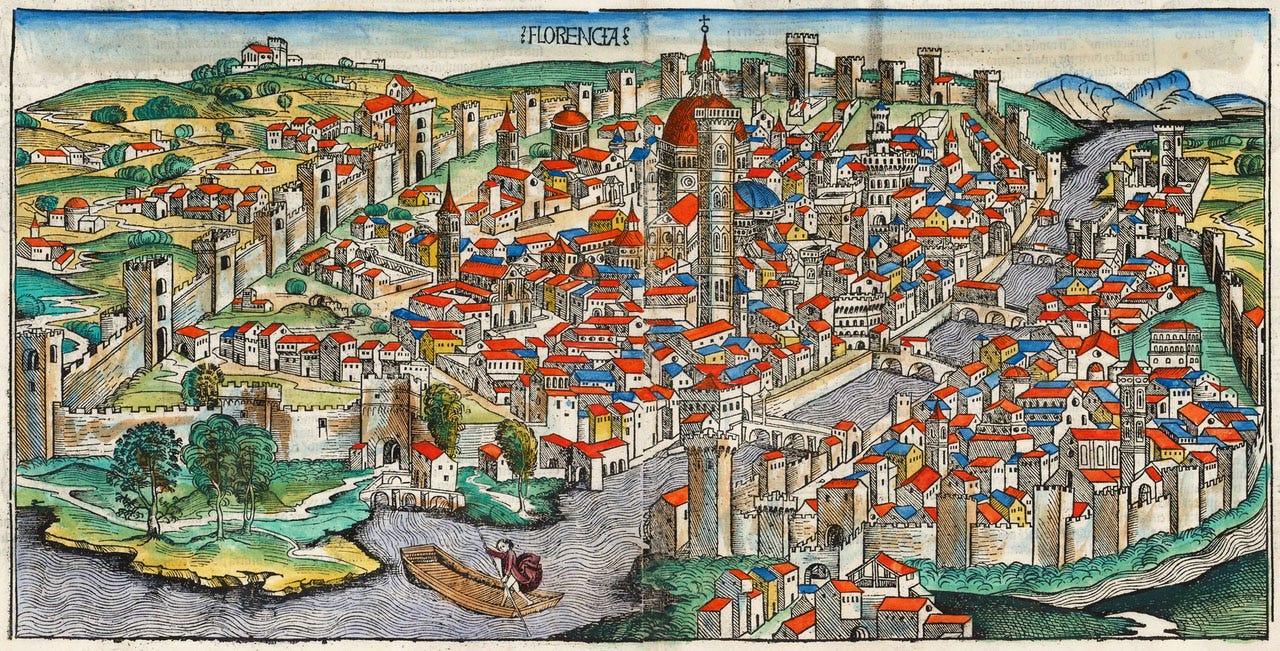
We take it for granted today that a map is an accurate top-down depiction of an area. So much so that the idea of calling anything else a ‘map’ would seem a misuse of the word. This, however, has only been the predominant thinking since Leonardo’s day.
Consider the above image of the city of Florence, produced by Michel Wolgemut just nine years before Leonardo crafted his own of Imola. It very much typifies the approach to cartography as it was in the 15th century. It would be incorrect, however, to say that technological limitations were the reason why cities appear so fantastical in such images. A map then, put simply, was an extension of art, a means of representing the real world within compositions that otherwise had a story to tell.
Allegory and symbolism was the order of the day — the accuracy of detail was of secondary importance compared to the spirit of the composition. It is for this reason that you were as likely to find a dragon as a mountain range on an early atlas, and why monuments tower over cities to an otherwise impossible degree in depictions of urban centers.
Cartography today is a science. Prior to the Renaissance it was an art, and no practical value was expected of a map any more than of a portrait. The thought of detailed street plans drawn to scale, indeed, was positively alien.
While the Age of Exploration incentivized the development of more functional nautical charts, on land it was the Italian Renaissance that sparked a revival of the more classical and mathematical approach to cartography.
A revival which Leonardo da Vinci, as the quintessential Renaissance man, would play a major role in…
The Mother of Innovation
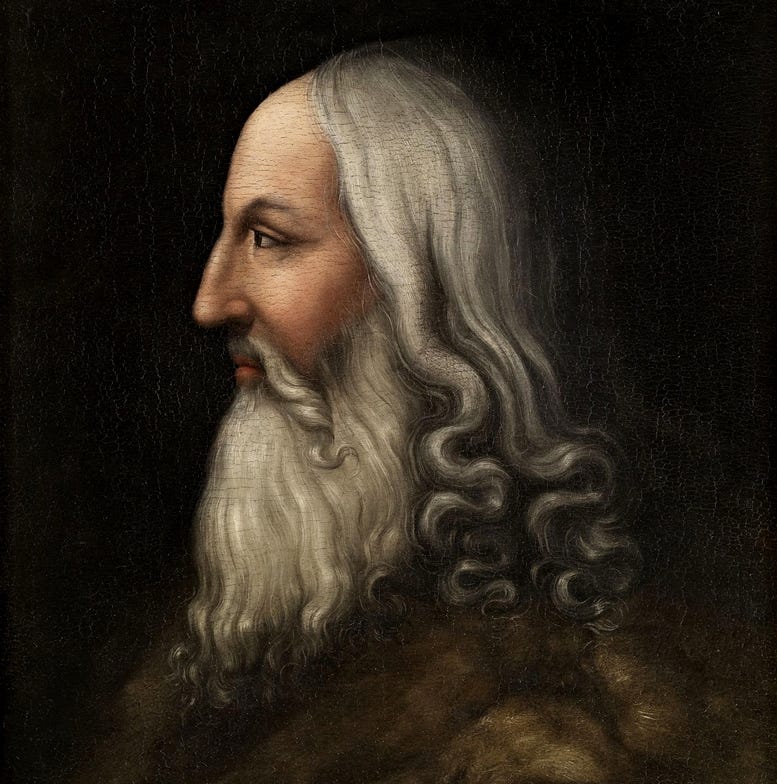
At the turn of the 16th century, Leonardo da Vinci was a man who had all but forgotten what it meant to have a stable life, much less a stable career.
For twelve years he had been in the employ of Ludovico Sforza, lord and later Duke of Milan, whose generous patronage had permitted Leonardo to pursue his scientific enquiries in relative peace and comfort. But in 1494, all assumptions were thrown out of the window when France, pressing her claim upon Naples, launched a fateful invasion of Italy. The times of grace were over, and those of war were here.
Leonardo himself would quickly be forced to confront this, when the one hundred tons of bronze he had carefully stockpiled for the project that was to be his magnum opus — the colossal equestrian statue of Francesco Sforza — was abruptly seized and melted down in order to cast weapons. When Ludovico was ousted and Milan herself fell to Louis XII of France in 1499, Leonardo’s life on the road began — a daunting prospect for a man on the cusp of his fifties.
Necessity, however, is the mother of invention, and a crisis can be the making as well as breaking of a man. Leonardo da Vinci, after all, was ironically well positioned to find work amid the chaos engulfing Italy. Few others, after all, possessed a greater fascination for machines or understanding of how scientific theory could be applied to practical use, both of which are readily applicable to war.
Often, all it takes is to be honest with ourselves about what we are good at, and then find a way to make a fulfilling living out of it. After months in the wilderness, in 1502 Leonardo sought out just such an opportunity, in the form of an ambitious man who valued his talents, and was prepared to pay well for them.
That man was Cesare Borgia, the ruthlessly effective son of Pope Alexander VI himself, who in the wake of the French invasion had carved out an Italian empire of his own. Over a series of lightning campaigns, he conquered the cities of Imola, and soon after Forlì, Rimini, Pesaro and Faenza. But Cesare, well aware that his new state was precarious, became especially concerned about securing it with adequate defences.
Cometh the hour, cometh the man, and following Cesare’s disastrous experience with another engineer, Francesco Spezante, Leonardo sensed his chance and offered his services. Thus on 18th August 1502, Cesare appointed Leonardo Architetto et Ingegnere generale, and ordered his men to grant the polymath free passage to survey the fortifications of the newly conquered cities, and “allow them to be seen, measured, and carefully estimated”.
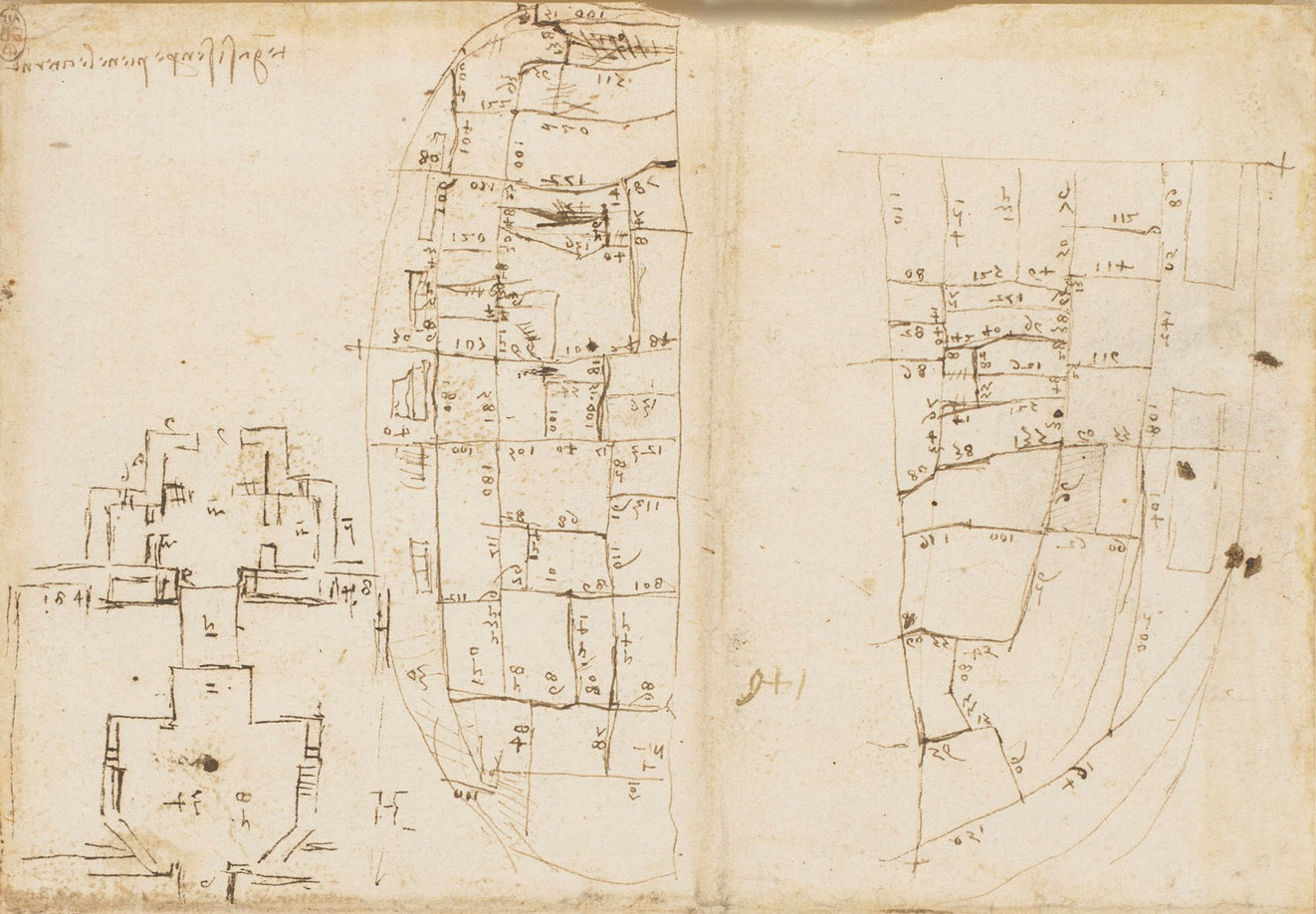
Three weeks later, Leonardo da Vinci arrived in an Imola swarming with men and arms massing for the next campaign season. To the troops, the middle-aged Leonardo must have presented an eccentric sight, pacing rather deliberately around the city, pausing to make the cryptic scribblings we can still today see in his notebooks, pictured above.
But what did the numbers mean?
