
How Tournaments Civilized Elites
From pagan bloodsport to Christian chivalry...


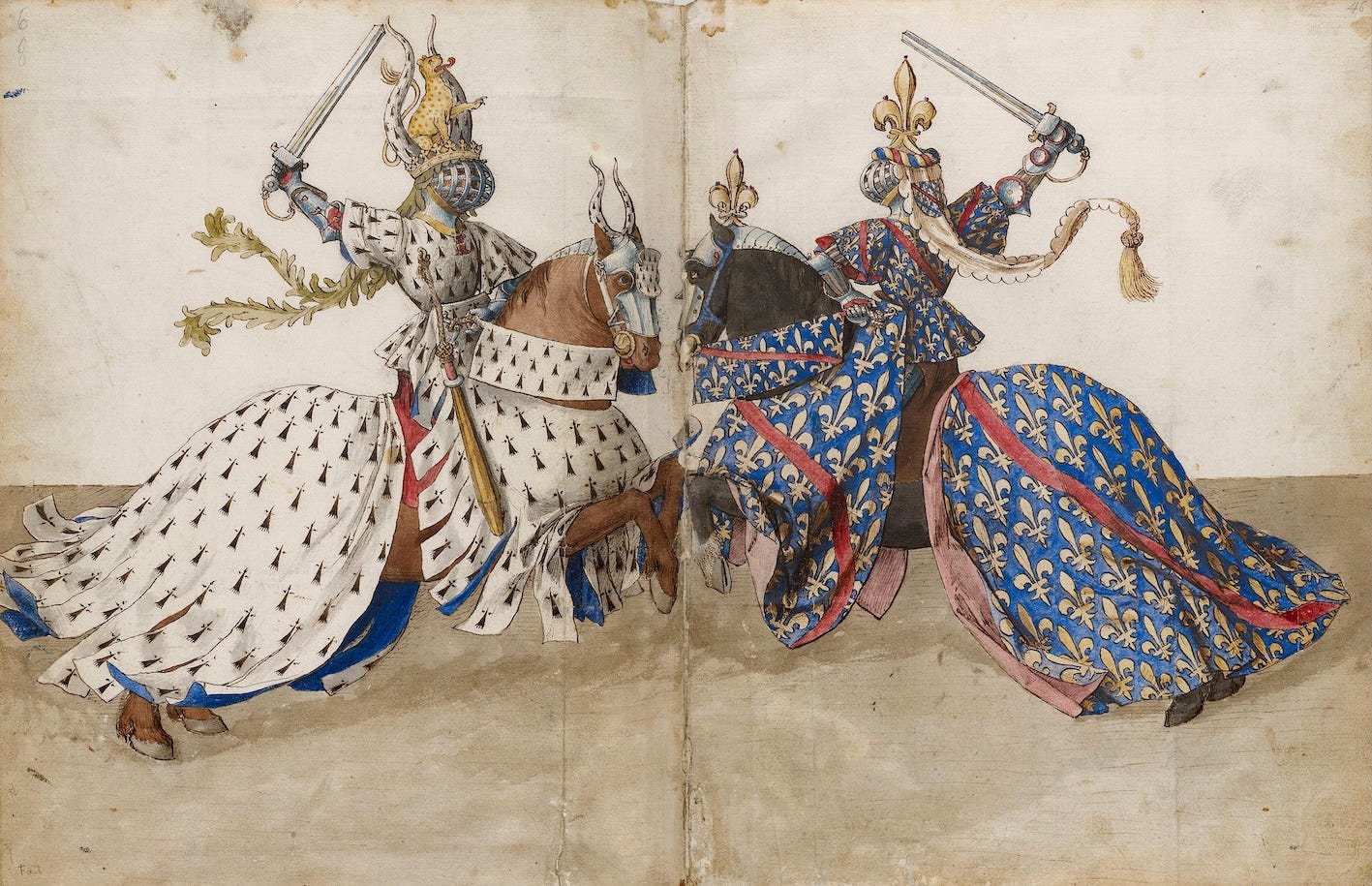
It is difficult to think of a more defining image of medieval Europe than the tournament.
Two knights, lances tilted and clad in the blazing colors of their houses, thundering down the lists, is a memorable spectacle indeed, and has been the wonder of young boys and marvel of men ever since.
Yet tournaments were of course more than simply a ‘sport’. For a time, they were not merely the image of, but the essence of a certain civilization. A civilization we today summarize as one of chivalry. European tournaments, after all, were not bubbles of fantasy, but an integral part of society for hundreds of years, and one that did not develop in isolation or without complication.
Violence as entertainment has of course accompanied man throughout his history, and Rome would famously harness it on a quasi industrial-scale on the sands of the amphitheater.
So how was the tournament able to civilize combat, and so too European elites?
Reminder: You can get tons of members-only content dedicated to useful knowledge, and support our Mission at the same time for a few dollars per month 👇
Two full-length, new articles every single week
Get actionable principles from history to help you navigate modernity
Access to the entire archive of useful knowledge that built the West
Support independent, educational content that reaches millions
Rome’s Guilty Pleasure
The concept of directing the violence of states through at least vaguely organized ‘duels’ is ancient indeed. Even in the foundational war of Western civilization — the Siege of Troy — the combat is written by Homer more as a series of ritualized duels between named individuals than as single great clashes of anonymous battle lines.
More than any others however, the Romans would largely dispense with the ceremonial element of warfare on the battlefield, transferring it instead to the arena. While in the earliest days this would be as connected to religious rites as it was entertainment, by the days of the Late Republic it was broadly accepted that hosting ‘the Games’ was simply another tool of politics.
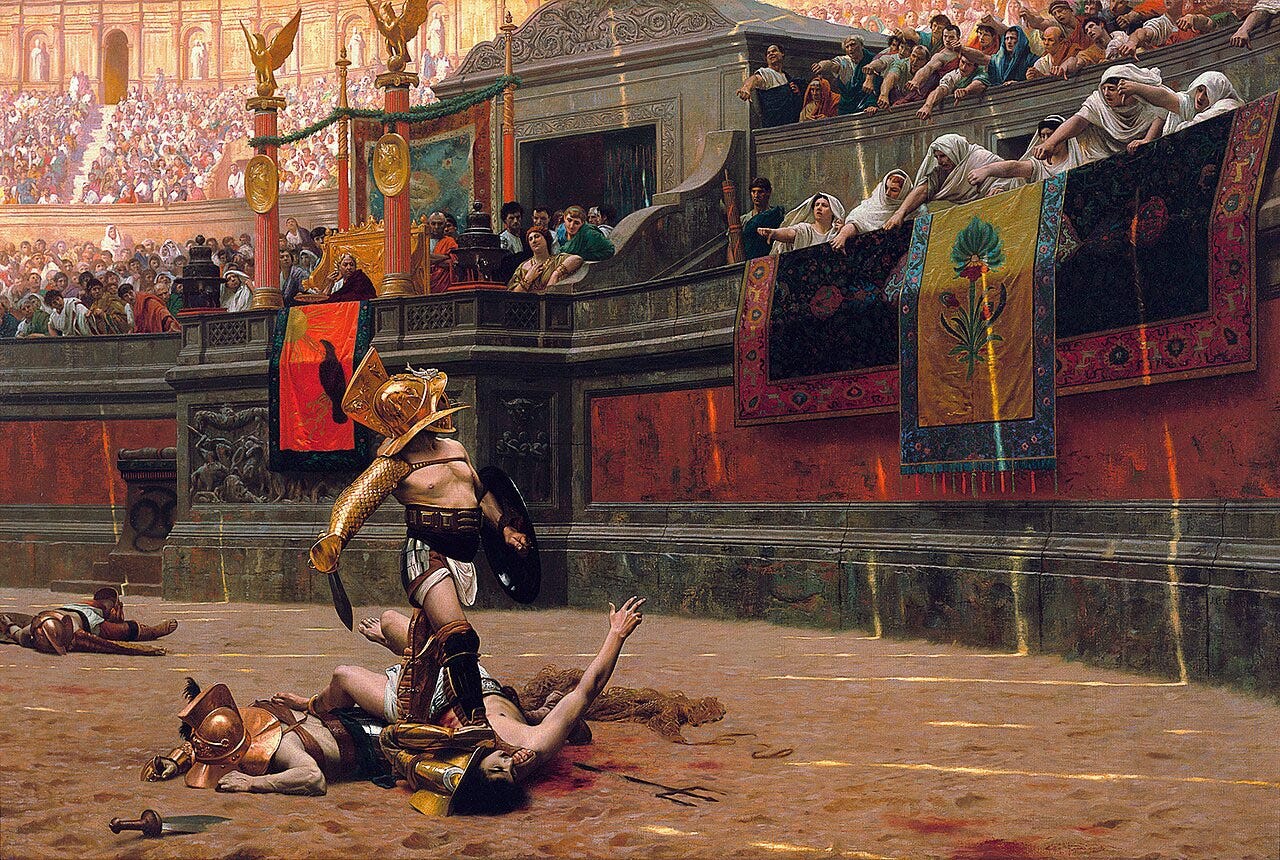
Candidates would front enormous sums of money, host the populace for a day, feed them, and dangle the prospect of spectacle in front of them. It is not hard, therefore, to see why Romans equated the gladiators who took the arena floor with actors who performed on the stage. It is well known that neither profession was considered respectable in Rome:
“Why, the authors and managers of the spectacles, in that very respect with reference to which they highly laud the charioteers, and actors, and wrestlers, and those most loving gladiators, to whom men prostitute their souls, women too their bodies, slight and trample on them, though for their sakes they are guilty of the deeds they reprobate; nay, they doom them to ignominy and the loss of their rights as citizens, excluding them from the Curia, and the rostra, from senatorial and equestrian rank, and from all other honours as well as certain distinctions”
Tertullian, De Spectaculis, 22
For many among the Roman elite, gladiatorial games were rather vulgar, and hosting them an unpleasant necessity for the pursuit of office. Not least because, as Tertullian relates above, the Games were often considered a magnet for both male and female immorality.
This, consequently, leads us to a critical difference between ancient bloodsport and medieval tournaments. In Rome, while watching the Games was practiced across society, participation was considered demeaning and restricted only to stigmatized classes. Augustus himself, while personally enjoying gladiatorial combats, made sure to exclude anyone “of respectable parentage” (Suetonius, Life of Augustus, 43) from competing. Similarly, the Emperor Commodus was widely derided by the city elite for fighting in the Colosseum, and following his murder, the senatorial decree of damnatio memoriae even stated “Cast the gladiator into the charnel-house” (Historia Augusta, Life of Commodus, 18.5).
In Rome, combat sport was essentially a profitable way to dispose of undesirables, or else goad slaves against each other. Medieval tournaments, however, were the exact opposite. It was the elites themselves who competed, and who wanted to compete…
The Return of the Games?
With gladiatorial games being definitively banned by the Emperor Honorius in AD 404, nothing like them would be seen again in Europe for many long centuries.
Over the course of those centuries, the Empire would crumble, yet Christianity would flourish. “Thou Shalt Not Kill” became an essential commandment, at least to be recited, even if not always practiced. Violence as entertainment — which had after all been the death of many martyrs — hardly seemed conducive to Christian states.
But states still fight wars, and still need men to both fight and lead those wars. Yet in an age before fully centralized control, when governance was delegated and autonomy celebrated, the possibility of local feuds and defiance of state authority was high. Rome, which had endured centuries of near continual civil war, with local governors habitually claiming the throne on a whim, never succeeded in reining in its unruly elites.
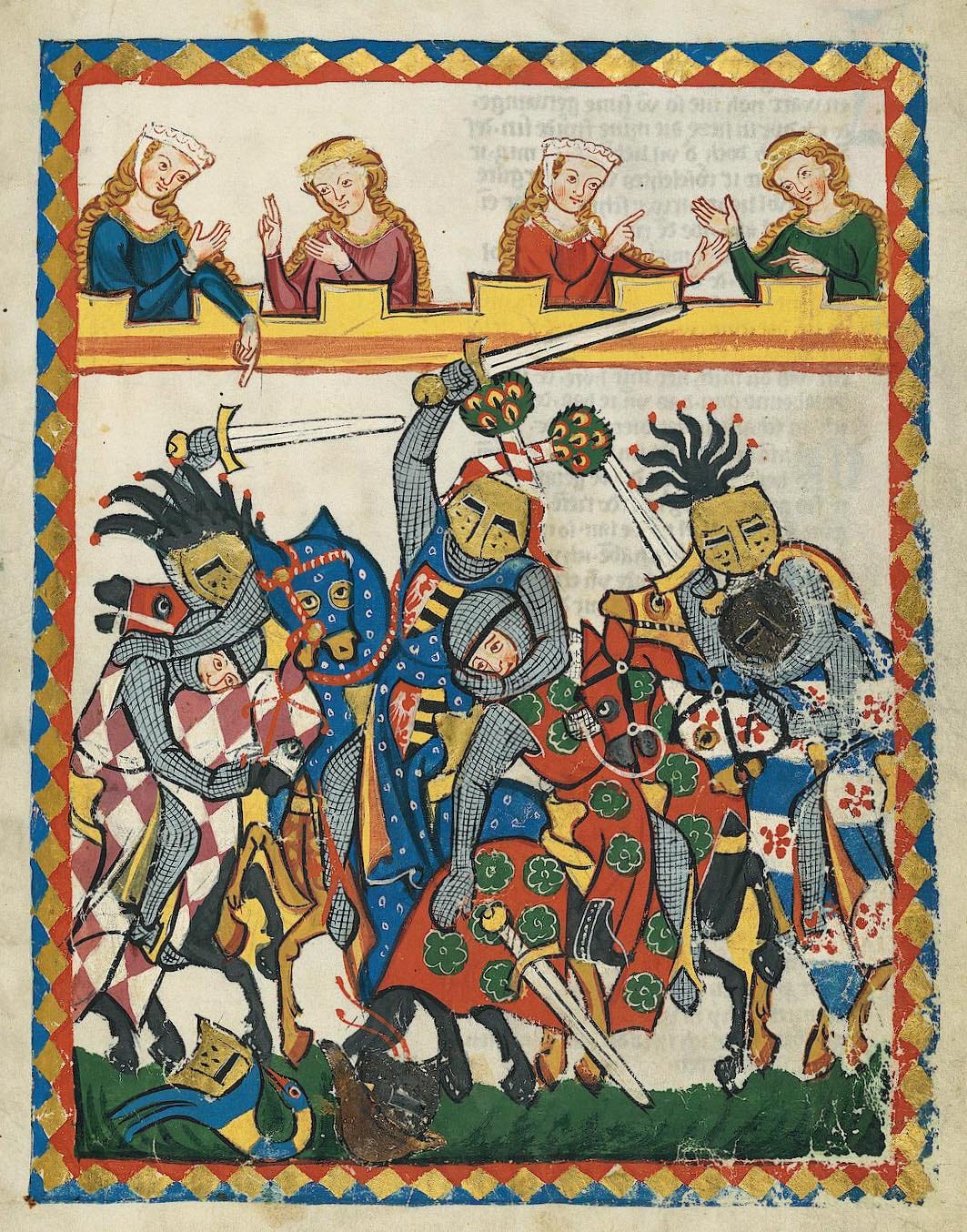
Yet from the days of the Charlemagne onwards, a solution would steadily begin to emerge to an unpleasant yet simple question — how can the ambitions of local nobles be redirected towards ends more wholesome than outright rebellion? At the same time, how can young and landless sons find purpose in an age of absolute primogeniture?
In the year 1066, Geoffrey de Preuilly, Comte de Vendôme, is alleged to have offered an answer:
“In the seventh year of the Emperor Henry and the third year of king Philip, there was treacherous plot at Angers, where Geoffrey de Preuilly and other barons was killed. This Geoffrey de Preuilly invented tournaments”
Pean Gatineau, Life of St Martin of Tours
In the early days, however, tournaments were ugly, undignified and scarcely better than Roman bloodsport. What had begun as sparring between the early knights of the Carolingian Empire developed into what were essentially private wars between feudal heirs. The first tournaments, indeed, tended to be an unpredictable mêlée, where any ‘rules’ existed more as a pretense to allow scores to be settled in public and without fear of legal repercussions. With the lack of any real ‘enforcing body’ however, situations could rapidly spiral into unruly brawls involving entire villages.
While it would be an exaggeration to say that deaths were ‘common’, serious injuries nevertheless occurred with unacceptable regularity, and a culture soon developed of profiteering, whereby prospective ‘knights’ competed not for glory, but simply booty.
It is hardly surprising then that the Church would soon say enough, with Pope Innocent II banning tournaments outright in 1130. Ironically, however, it was the condemnation of the Church which transformed tournaments from the moral weakness of the elite into their most virtuous strength…
