
Empire as Destiny: America vs. Athens
Modern Lessons from the Ancient Athenians


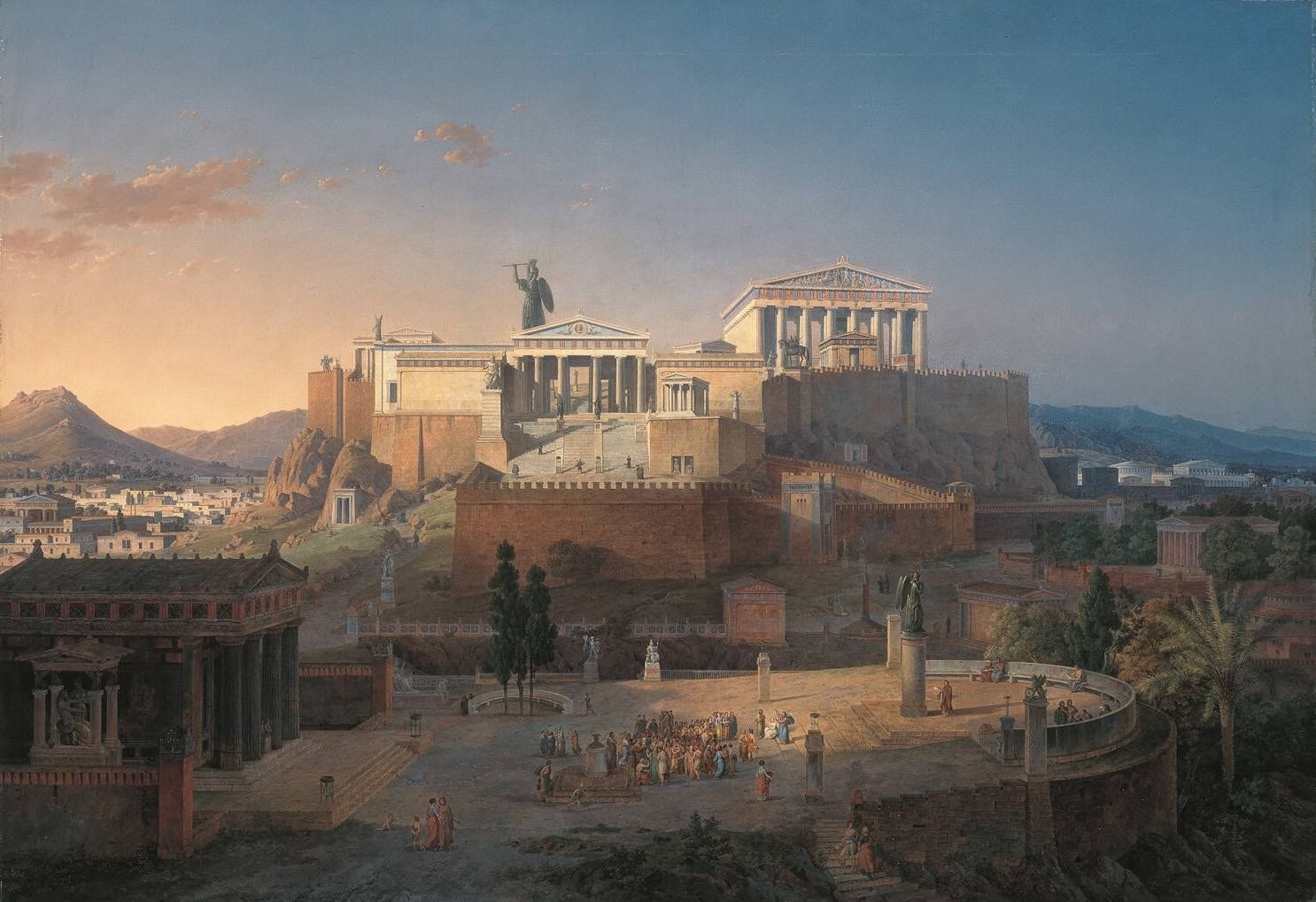
Right, as the world goes, is only in question between equals in power, while the strong do what they can and the weak suffer what they must. — Thucydides (History of the Peloponnesian War)
From the earliest chronicles of human society, empire has stood as one of the most formidable and contested expressions of political will. To the classical historian, empire appears as the natural culmination of a polis or kingdom that has outgrown its provincial boundaries. To more modern political theorists, it is the inevitable destiny of a culture that has entered its civilizational phase, when expansive energy replaces creative inwardness.
Whether admired as an engine of order or condemned as a vehicle of domination, empire remains a recurring phenomenon in the long arc of Western history. Its logic is older than Athens, older than Babylon, older even than the first city walls raised against the wilderness. It is rooted in the fundamental truth that human communities, like organisms, seek security, influence, and permanence in a world shaped by ceaseless competition and violence.
The case for empire can be seen clearly through the lens of Ancient Athens, whose rise from a modest polis to the hegemon of the Delian League offers a paradigmatic example of imperial formation — not merely for the sake of domination but as a bulwark against rival powers. Similar principles echo in modern geopolitical considerations, such as debates over whether the United States might annex neighbouring territories like Greenland, alongside sober warnings about the inherent dangers of imperial overreach.
For just as Athens rose to imperial glory, it also fell — undone by a smaller but more militaristic rival, serving as a perpetual reminder that hegemony is never secure unless it remains vigilant.
Reminder: You can get tons of useful members-only content and support our mission for a few dollars per month 👇
Two full-length, new articles every single week
Access to the entire archive of useful knowledge that built the West
Get actionable principles from history to help navigate modernity
Support independent, educational content that reaches millions
The Athenian Empire
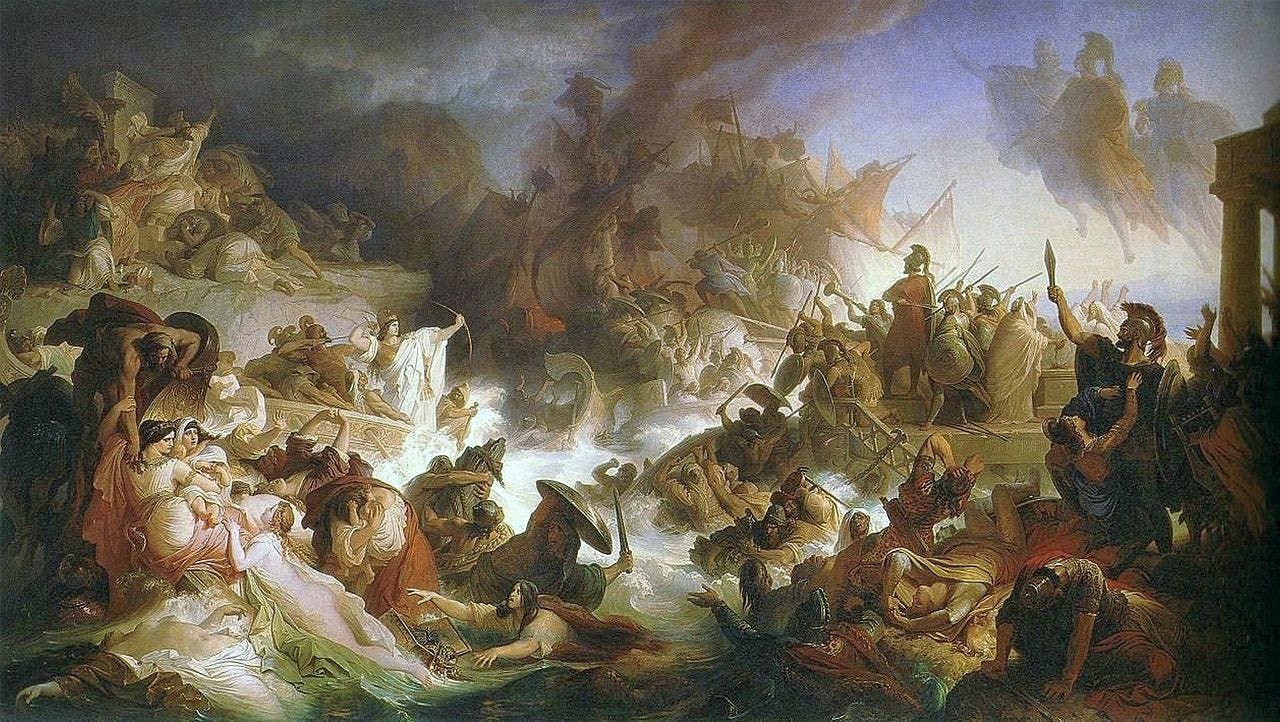
The Athenian Empire did not emerge in the 5th Century BC from a premeditated blueprint but from the contingencies of war, alliance, and opportunity. In the aftermath of the Persian Wars, the Greek world developed a new sense of cultural identity while facing a vacuum of leadership. While the Persians remained a real and tangible threat from across the Aegean Sea, the smaller Greek city-states lacked the resources to defend themselves in the event of another coordinated invasion. Athens, having developed a formidable navy from their heroic defence of their homeland and a renewed sense of destiny, stepped into this political void.
The Athenians formed the Delian League, initially conceived as a voluntary alliance of Greek city-states for the purpose of mutual defence. However, this gradually transformed into an Athenian-led empire that extended from mainland Greece across the Aegean to the many islands and coastal cities of Asia Minor. As Athenian power solidified, the character of the alliance changed accordingly. Tribute replaced contribution, garrisons replaced goodwill, and Athens, once the champion of Greek freedom, assumed the role of hegemon over the Hellenic world. The taxes extracted from their allies funded building projects and ushered in what later observers would recognise as the Golden Age of Ancient Greece.
Yet to the Athenian mind, this transformation was not merely self‑serving — it was justified by political necessity. Empire, they believed, was the natural reward for their sacrifices against Persia and the only means of ensuring continued security. As Thucydides records, the Athenians insisted that their conduct followed the universal logic of power, declaring that “we have done nothing extraordinary, nothing contrary to human nature, in accepting an empire when it was offered to us and refusing to give it up under the pressure of adversity.” Relinquishing their empire, the Athenians argued, would invite chaos, embolden their enemies, and betray the very allies who depended on their strength.
The Justification for Empire
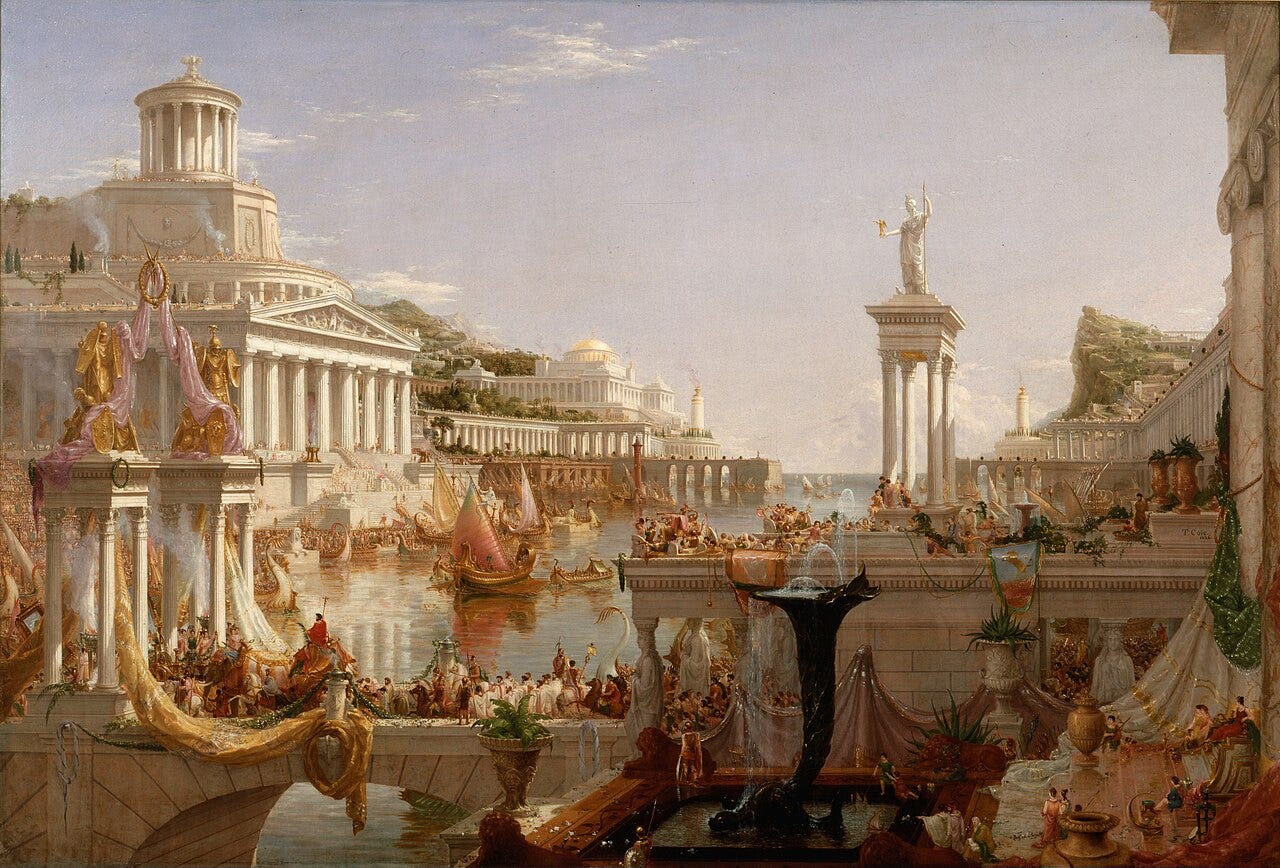
The unification of diverse peoples — whether by conquest, alliance, or assimilation — has long been defended as a means of safeguarding them from external threats. In a world where rival powers constantly seek expansion, small and culturally distinct communities often face a stark choice: either join a larger political entity or risk cultural and political annihilation. Empire, in this view, becomes a protective umbrella, a structure that absorbs difference while shielding it from predation.
Athens’ empire illustrates this dynamic with particular clarity. The Aegean city-states, though culturally Greek, were politically fragmented and militarily weak. Their survival against Persia depended on collective action, and Athens provided the naval strength that made resistance possible. As its power grew, Athens came to regard itself as the natural centre of the Greek world, and its leadership gradually assumed a harder, more commanding form. The shift was not abrupt but organic, the unfolding of a polis entering its imperial phase. The infamous confrontation between Athenian and Melian envoys reveals this transformation in its purest expression.
As a neutral island and culturally Greek — yet unwilling to accept Athenian authority — Melos became the stage on which Athens articulated the worldview of a rising civilization. When the Athenian envoys arrived, they did not appeal to a shared identity or past cooperation, but spoke with the directness of a people conscious of their destiny. In Thucydides’ account, they dismissed all moral argument made by the Melians, declaring that “Right, as the world goes, is only in question between equals in power, while the strong do what they can and the weak suffer what they must.” In this infamous statement, Athens served as a perpetuate archetype of the moment when a rising civilization ceases to justify itself through ideals and accepts power as the only law that endures.
To the Athenians, this was not a betrayal of earlier ideals but their natural culmination. They believed their empire preserved the Greek world from a far greater domination, and that only a unified power could withstand the forces pressing in from beyond the Aegean. The Melian Dialogue shows how this conviction hardened into a broader understanding of history itself — that cultures, once awakened to their strength, expand outward with the inevitability of living organisms. The movement from leadership to dominion was therefore not a moral choice but a civilizational necessity, the expression of a will that no longer sought justification but simply acted.
To unify peoples is therefore not merely an act of domination but a form of mutual self‑preservation, a consolidation of strength that binds disparate communities into a single defensive organism. The empire, therefore, becomes a political fortress whose walls are built from shared security, and in this sense it stands as one of the most effective political forms and enduring civilizational strategies. Like any great enterprise, those who possess the greatest stake in the empire’s survival become its most committed defenders since their fortunes rise and fall with its successes or failures. In return, they are the first to partake in the spoils of expansion — land, wealth, and influence — forming an elite whose fortunes are inextricably bound to the imperial order.

The Pax Americana
The rise of the United States after the Second World War reflects a pattern already visible in the ascent of Athens. Just as Athens emerged from the Persian Wars as the only Greek power capable of organizing collective defence, the United States found itself, after 1945, uniquely positioned to shape the direction of the Western world. In both cases, a single state accumulated the resources, military capacity, and strategic reach necessary to impose coherence upon a fractured landscape. What followed was not a calculated project of domination, but the natural expansion of a power whose vitality had expanded beyond the confines of its original constitution.
With Europe shattered, Asia destabilised, and the old imperial order collapsing, the United States stepped into a geopolitical vacuum much like the one Athens confronted in the Aegean, and the onset of the Cold War only accelerated this transformation.
Faced with a rival superpower and a global ideological contest, the United States did not so much choose hegemony as much as it was forced to embrace it. In doing so, the weakened nations of the West gravitated toward the only force capable of sustaining them, and the international system coalesced around the new American centre of gravity. In this sense, American hegemony emerged as the civilizational response to a world drifting toward chaos and uncertainty — a consolidation of power compelled by circumstance rather than ambition, echoing the same logic that once drew Athens from leadership into empire.
Within this broader historical rhythm, the periodic debates surrounding potential American interest in annexing neighbouring territories such as Greenland reveal how imperial logic persists beneath the surface of modern diplomacy. Greenland’s vast natural resources, its commanding position in the Arctic, and its growing relevance in future geopolitical competition make it an object of interest for any state seeking to maintain global primacy.
To mention this is not to endorse annexation but to recognise that the calculus resembles that of earlier empires. A powerful state perceives a territory of strategic value; it considers whether incorporating or influencing that territory would enhance its security; and it weighs the benefits against the diplomatic and moral costs. Just as Athens sought to secure islands like Melos in the Aegean to shield itself from Persia, so the United States evaluates territorial influence as both a self‑serving act and a means of preserving the order it anchors.
The forms have changed, but the underlying will — the expansive impulse of a civilization in its imperial phase — remains the same.
The Fate of Empire
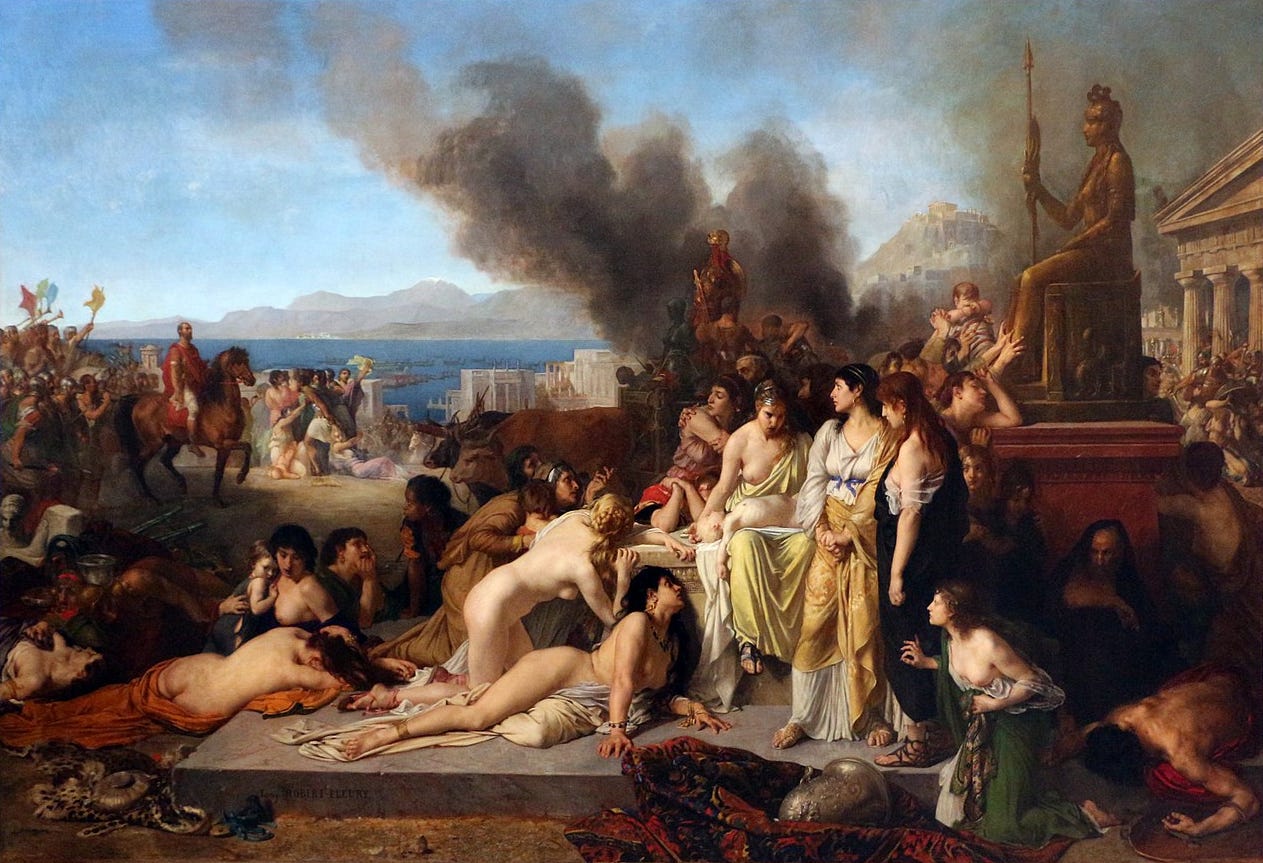
History may justify empire, but history also records its limitations. Powers that expand without properly binding their subjects to a shared destiny, or without sustaining the strength that first carried them to greatness, eventually feel the political foundations shift beneath them until they inevitably collapse.
Decline is the recurring rhythm of civilizations, not a sudden catastrophe but the slow exhaustion of a form of life that has passed its zenith. When the outward surge of expansion reaches its apex in the much anticipated Golden Age, a subtler decay begins: administrative burdens accumulate, corruption and decadence spread, cultural cohesion loosens, religion and morality fade, and rival powers recognise the moment to challenge the hegemon.
Athens followed this trajectory with unmistakable clarity. Its empire, sustained by naval supremacy and enforced tribute, grew increasingly resented by the subjects it once called allies. Confidence slipped into complacency, political unity frayed, and dependence hardened into open hostility. In this climate, Sparta moved into the space created by Athenian overreach, and the Peloponnesian War shattered the illusion that past greatness could guarantee future security.
Empire is never a fixed achievement but a living structure that must be continually renewed. It endures only so long as its ruling power maintains the strength, discipline, and integrative force that first brought it into being. When these qualities fade, even the most formidable hegemon becomes vulnerable to forces it once held in check. This is the enduring lesson of history: imperial power is rarely lost in a single blow, but through the gradual abandonment of the very principles that led to greatness.
Join the fight for the Soul of our Civilization!
By Subscribing to Atlas Press, you are supporting an honest group of guys who are working to help revitalize Western Civ through the re-enrichment of the mind.
You seem to have conveniently left out what happened after the Athenians invaded Melos; they executed all men of fighting age, and sold the women and children into slavery- hardly an ideal for Americans to strive for.
Perhaps the Athenians should’ve ruled themselves with the virtues expounded by Socrates (whom they murdered, yet whose dialogs inspired the US founding fathers).
True leadership cannot be coerced, followers can only be led by invitation.
This also follows the writings by French philosopher Alexis De Tocqueville who observed (paraphrasing) “America is great, because America is good. Once America ceases to be good, it will cease to be great”
I would also argue it was Pericles’ hubris that *quickly* led to Athens’ downfall.
The Melian Dialogue critique is valid but kind of misses the article's point. The piece isn't endorsing brutality but analyzing why empires form - security vacuums pulling in the strongest power. The comparison works because both Athens and postwar US didn't plan hegemony, they inherited it. The decay mechanism is interesting - when imperial powers lose the disipline that built them, challengers emerge. Rome lasted centuries, Athens barely decades, which suggests the renewal part matters way more than initial conquest.