
Charisma and Democracy: The Return of Caesarism
The path of Caesar clears the way for a new Augustus


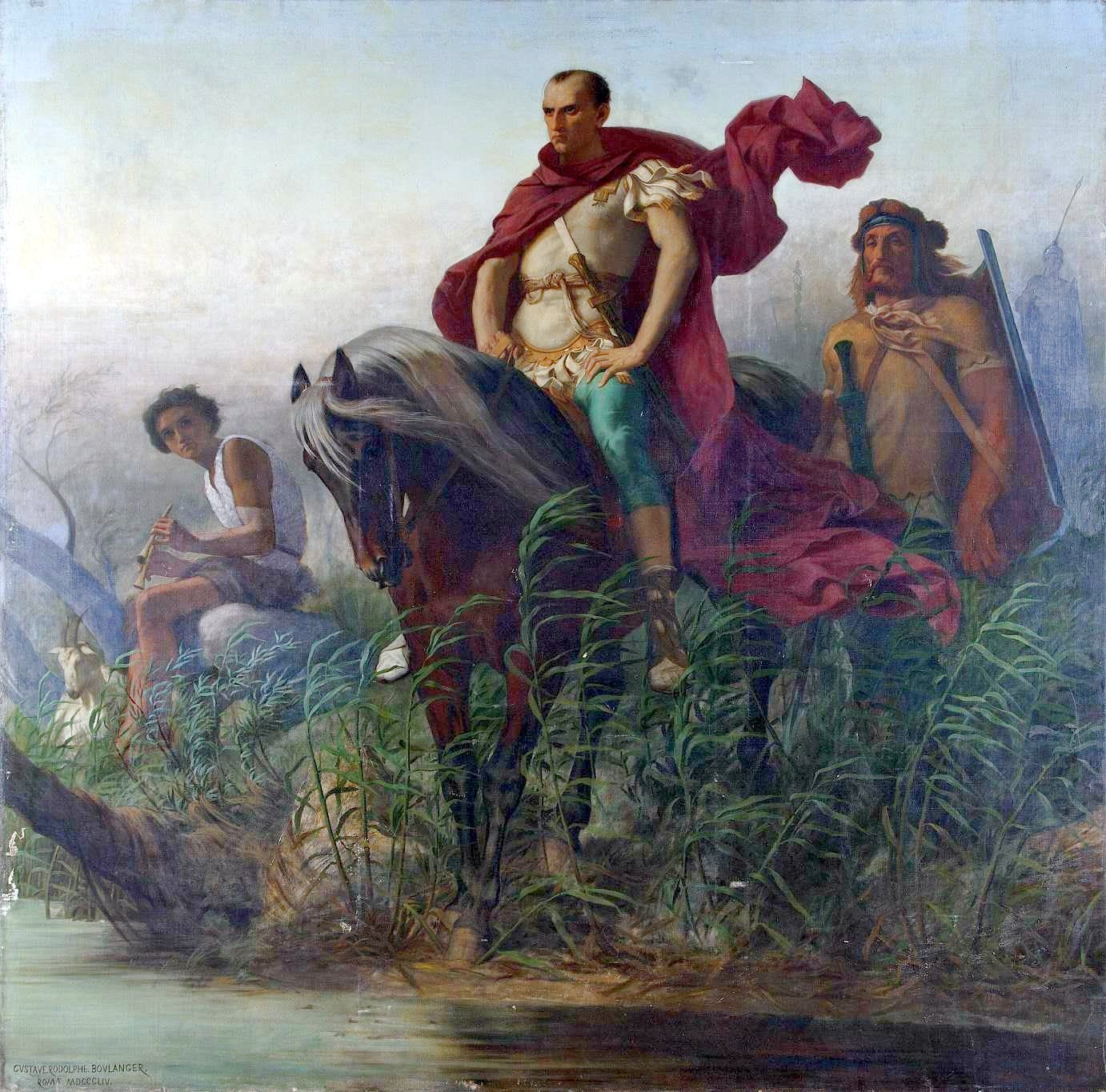
Trump’s second presidency can be read as a decisive move toward Western Caesarism—rarely have historical echoes between past and present appeared so stark.
In ancient Rome, much like in today’s Western world, societies confronted the fate of participatory governance amid civilizational exhaustion, political estrangement, social fragmentation, and an intensifying desire for strong leadership. Both the late Roman Republic and the contemporary West reveal a strikingly similar tension: between formal civic engagement and real democratic impotence, between republican ideals and the accelerating concentration of power in oligarchic hands.
The EU readily invokes democracy as a fundamental value of European identity: equal political participation, transparency, the rule of law, and representation are meant to form the Union’s political foundation. Yet the Eurobarometer’s “democracy index” repeatedly reveals considerable dissatisfaction. Only 57% of Europeans report being satisfied with democracy within the Union, and the nation-state fares little better: on average, just 58% of EU citizens are satisfied with how democracy functions in their own country.
Meanwhile, election after election sees growing numbers casting their votes for right- (and left-) wing protest parties that promise to disrupt what they describe as a “stagnant” system or “party cartel.” It is therefore unsurprising that in France in early 2025, as many as 73% of citizens supported the idea of “a real leader” who would finally “restore order,” and 40% were prepared to abolish parliament and elections in order to grant such a leader the necessary freedom of action.
And the situation in the US was all but different towards the end of the Biden administration…
Reminder: You can get tons of members-only content dedicated to useful knowledge, and support our Mission at the same time for a few dollars per month 👇
Two full-length, new articles every single week
Get actionable principles from history to help you navigate modernity
Access to the entire archive of useful knowledge that built the West
Support independent, educational content that reaches millions
Crisis and Fall of the Roman Republic
This growing skepticism, coupled with the longing for a strongman, is strikingly reminiscent of the late Roman Republic, when the Roman people gradually became alienated from the political class and defined themselves in opposition to it. Formally, republican institutions continued to exist in the first century BC. Yet the heart of the Republic—the Senate—had come to be dominated by the office-holding aristocracy, the nobilitas, who primarily pursued their own interests and allowed hardly any newcomers to reach the highest magistracies. Sallust repeatedly lamented that the republican ideal had become little more than a façade, as magistracies had been reduced to spoils for ambitious political dynasties whose internal agreements and patronage networks replaced any orientation toward the common good.
“For among our ancestors there was one commonwealth for which all cared alike; party spirit was directed against the enemy; each man exercised body and mind for his fatherland, not for his own power. But in our time, by contrast, the men of the nobility—whose minds have been infected by dullness and sloth, strangers to exertion, enemies, and military service, fortified at home in cliques and arrogant toward all nations—have reduced the state to chaos. Thus the senators, whose wisdom once strengthened a wavering commonwealth, are now driven to and fro by foreign desires; at one time they decide one thing, at another something else; as the hostility or favor of those who rule dictates, so they judge public good and evil.” (Sallust, Letter to Caesar 1.10.8–11.1)
As this oligarchy proved increasingly incapable of overcoming the backlog of reforms that had accumulated as Rome’s city-state administrative structures expanded into a world empire, more and more independent-minded politicians emerged who sought to remedy various grievances not in alignment with the elite, but in opposition to it. From the Gracchi to Marius and Sulla, and from Pompey to Caesar, the history of the late Republic was marked by tragic and failed reform attempts of all kinds. Time and again, these efforts shattered against the inertia of the status quo, yet at the same time they undermined trust in state structures and political elites, thereby gradually preparing what the latter sought with all their might to prevent: the rise of a charismatic ruler.
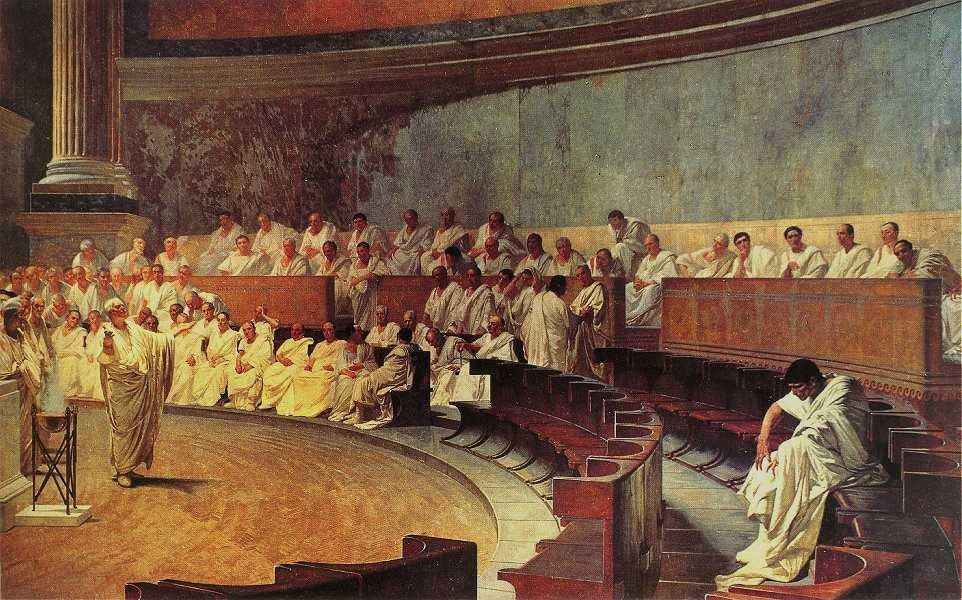
It is therefore hardly surprising that these prominent individuals gradually ceased to see themselves as reformers and began instead to regard themselves as quasi-monarchical heads of state in waiting, shaping their policies accordingly and even exacerbating the very chaos that would bring them to power:
“As for the respectable citizens, for these reasons they withdrew entirely from public affairs, so that the city at one point remained without government for eight months. Such was the disorder, while Pompey deliberately allowed matters to grow worse so that the need for a dictator might be felt. Many spoke privately to one another, saying that the only remedy for the existing situation was the rule of a single man—but he should be both powerful and moderate—and by this they meant Pompey […]. He himself, of course, rejected all such proposals publicly; yet in truth his entire secret conduct aimed at that very goal, and it was deliberately and intentionally that he allowed the state to lapse into disorder, and from disorder into complete anarchy.” (Appian, Civil Wars 2.19–20)
The West on the Path to Caesarism?
Europe, too, is experiencing a period of profound political dissatisfaction. The modern citizen, like the Roman plebeian before him, gradually withdraws from active political participation and adopts a stance of fundamental opposition. The causes are similar: a growing sense of powerlessness in the face of complex political processes, the absence of genuine decision-making alternatives, and the increasing dominance of an elite legitimized partly by technocratic, partly by economic credentials—an elite that has replaced democratic self-justification with opaque agreements, ideological “firewalls,” and coalitions of losers.
Within the EU, this manifests itself not only in the power of the unelected Commission, which nevertheless makes key decisions; the EU Council, too, operates largely behind closed doors. Even in the nation-states, only broad, left-leaning “centrist” alliances of so-called “democratic” parties prevent the integration of protest forces, so that citizens perceive politics not as the result of their own participation, but as the execution of measures that scarcely reflect the needs of the majority.
It is therefore no wonder that the conviction is gradually taking hold that democratic or republican structures have become mere façades. Consequently, forces outside the elite form comprehensive alliances modelled on their opponents, effectively suspending the foundations of the separation of powers—albeit under reversed ideological signs. In Rome, the consensus of the nobilitas was followed by the discreet agreements of the First Triumvirate; in the United States, the Democrats’ “deep state” has been replaced by the alliance between Trump, Musk, and a large segment of the tech elite. In both cases, through a mixture of intimidation, populism, propaganda, bribery, disruptive personnel policies, personality cult, and the force of faits accomplis, a host of constitutionally questionable measures were pushed through against the will of the oligarchy, thereby creating authoritarian precedents from which there can be no return.
Although the masses celebrate these developments as the apparent implementation of a “democratic” mandate, it is clear that even under new conditions, respect for the majority’s will is less the necessary result of institutional mechanisms than the consequence of individual ambition. The diffuse desires of the masses serve merely as a springboard for a position of power that, at least in intention, is never meant to be relinquished—even in the face of shifting political moods.
Caesar and Augustus
In this vacuum of power, charisma and Caesarism increasingly come to the fore: fascination with the strong, seemingly independent leader, and the reduction of political struggle to a confrontation between towering personalities who replace parties and ideologies altogether and fall into increasingly violent rivalry—after all, the stakes are nothing less than world domination.
In first-century BC Rome, it was Gaius Julius Caesar who first emerged victorious from the struggle against his rivals and embodied not only the hope of restoring order but also the masses’ struggle against their disenfranchisement by the oligarchy. His personal magnetism, his generous donations, his military victories—all this made him, for a time, a darling of the masses, even as he gradually dismantled the Republic and replaced it with a sacral, monarchical legitimacy more reminiscent of Hellenistic ruler cult than of republican ideals.
Yet neither the senatorial aristocracy nor the people were ultimately prepared for such a revolution—even if staunch defenders of the old Republic such as Cicero understood that stabilizing the political situation without some form of monarchical concentration had become impossible:
“Thus this is the first form, appearance, and origin of the tyrant […]. Opposed to him is the other man—the good and wise one who understands the welfare and dignity of the citizens, a kind of guardian and steward of the commonwealth; for so should be called anyone who is the helmsman and pilot of the state. See that you recognize this man; for he it is who can protect the citizen body through counsel and active effort.” (Cicero, De re publica 2.29)
The Ides of March demonstrated clearly that it is seldom the first caesaristic autocrat who succeeds in founding a lasting new order. The transition from initial authoritarian reforms to enduring monarchy is slow and, above all, bloody—particularly when political tradition rests upon the fundamental assumption of participation.
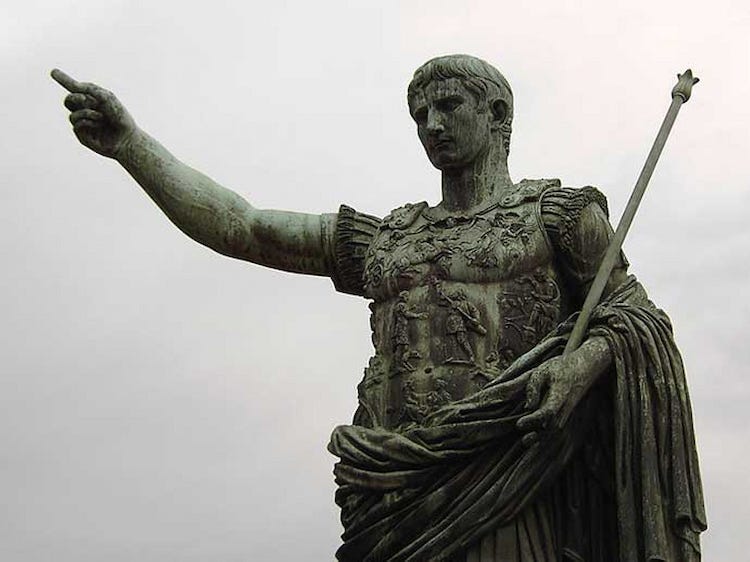
Today we are witnessing, evidently, the return of the charismatic leader—most prominently, though not exclusively, in the United States, where Donald Trump within a matter of months has translated central caesaristic methods into the political reality of the twenty-first century in a manner almost caricatural—instinctively recognized as such by his opponents in the “No King” movement. This may not make Trump the Western “Caesar” as such, but certainly one of the many coming Caesars whose largely personal and scarcely ideological-institutional rivalries will shape the future.
Political prognostication is always a delicate matter. Yet not only Caesar’s example, but also that of comparable rulers such as Qin Shi Huangdi in China, Horemheb in Egypt, or Kavadh I in Iran, suggests that the era of a final civilizational empire may be drawing near—even if it is not yet fully on the agenda. Rather than stabilizing the current situation, the United States is likely to experience the collapse of the hastily constructed new power structures and a renewed period of chaos, until in some years’ time the arrival of a true Augustus (or a Han Gaozu, a Sethos, or a Khosrow) may occur. Should circumstances not change swiftly, Europe will in this development play little more than the role of a provincial spectator—and subject.
 | A guest post by
|
Very compelling. If you’re correct the bloodbath will unleash (in the US) the very moment the orange 🍊 passes (they’re already salivating about succession). My second thought is: then it was men. Now it is men. The only way to break this recurring nightmare is to give women their due.
https://www.justgiving.com/team/shakih-imran-ahmed-3?utm_medium=team&utm_content=shakih-imran-ahmed-3&utm_source=copyLink&utm_campaign=pfp-share&invite=true